
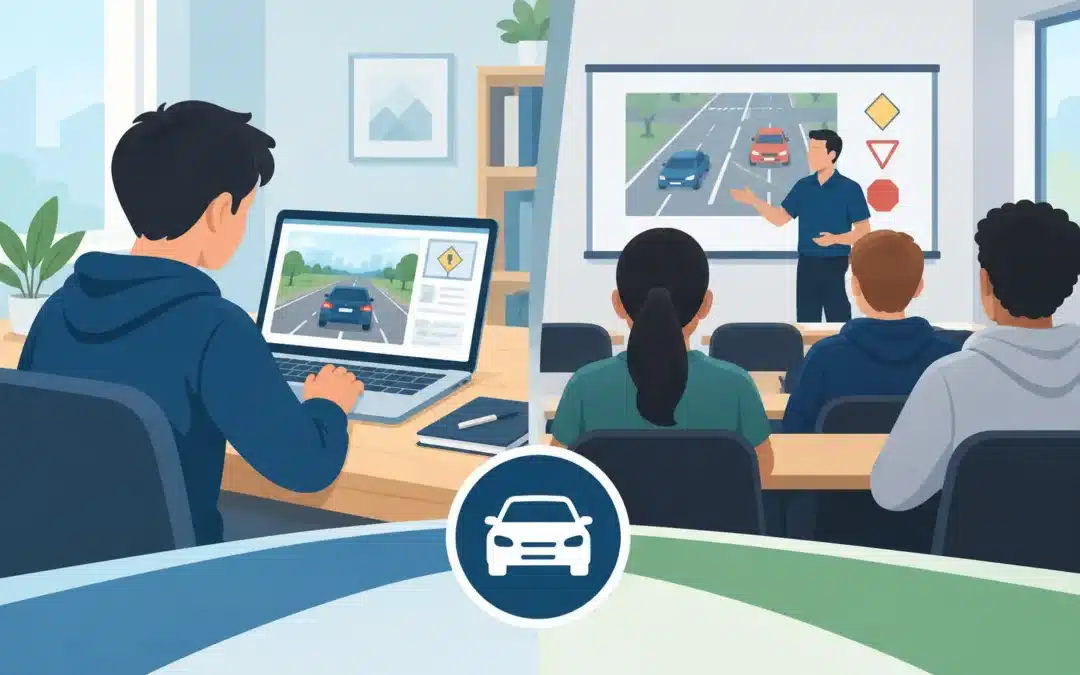
A teenager may be ready to start the permit process, but the family calendar may not be ready for another fixed weekly commitment. That is why the choice of online versus classroom driver education matters. Both options can teach the rules of the road required for a California learner’s permit. The better choice is the one your teen will complete carefully, on time, and with enough attention to carry those lessons into real driving.
What California Driver Education Is Meant to Do
Driver education is the knowledge portion of a teen’s licensing journey. Before applying for a California learner’s permit, most teens under 18 must complete a DMV-approved driver education course. The course covers traffic laws, signs and signals, sharing the road, defensive driving, distracted driving, alcohol and drug awareness, and the responsibilities that come with a license.
It is not the same as behind-the-wheel training. Driver education explains why a safe lane change requires scanning mirrors and blind spots. Behind-the-wheel lessons give a new driver the chance to practice that sequence in a real vehicle with a qualified instructor. Teens need both parts of the process, along with the required supervised practice with a parent or guardian.
The format does not change the purpose. A legitimate course should be DMV licensed, designed for California requirements, and able to provide the documentation a student needs after successful completion. What changes is how the student receives the instruction and how much flexibility the family has while completing it.
Online Versus Classroom: The Practical Differences
Online driver education lets students work through lessons on a computer, tablet, or phone from home. Classroom driver education takes place at scheduled times in person, usually with an instructor leading a group of students. Neither format automatically produces a safer driver. Consistent effort, comprehension, and quality instruction matter more than whether the lesson happens at a desk at home or in a room with classmates.
For many California families, scheduling is the largest difference. Online instruction can fit around sports, homework, jobs, family plans, and changing school schedules. A teen can make progress after school or on a weekend without needing a ride to a class location. This is especially helpful for parents managing work schedules or coordinating activities for more than one child.
Classroom instruction offers a set routine. Some students do better when they know they must arrive at a particular time, sit with an instructor, and keep pace with a group. They can raise a hand when a topic is unclear and hear questions from other students. For a teen who tends to postpone independent work, that external structure can be valuable.
The trade-off is straightforward: online education provides flexibility, while classroom education provides more built-in accountability. Families should choose based on their teen’s habits, not based on the assumption that one method is easier.
When online driver education is a strong fit
Online education is often a practical choice for a self-directed teen who can read carefully, follow instructions, and complete a course in small, regular sessions. The student can pause to review an unfamiliar rule, work at a comfortable pace within course requirements, and return to lessons without missing a scheduled class.
It also reduces a common source of delay: transportation. A teen in Anaheim, Fullerton, Yorba Linda, or nearby North Orange County communities can begin the education portion without waiting for a parent to drive them to an evening class. That convenience can help families get the permit process moving sooner.
Still, flexibility needs a plan. An online course should not become something a teen opens once, then ignores for weeks. Parents can help by setting a completion target, checking progress periodically, and asking their teen to explain what they learned. A short conversation about right-of-way rules or freeway merging can show whether the information is sticking.
When a classroom may be the better choice
A classroom setting may work better for teens who learn best through live discussion or need a regular appointment to stay focused. An instructor can add examples, clarify confusing material in the moment, and keep a group moving through the curriculum. This can be reassuring for parents who prefer a more traditional learning environment.
The downside is less flexibility. Missing a class may mean waiting for a makeup session, and the schedule must work with school, activities, and family transportation. Before enrolling, ask when classes meet, what happens if a student is absent, how long the course takes, and whether the provider is properly licensed for California driver education.
Classroom learning also does not remove the need for study. The California knowledge test requires a teen to understand the California Driver’s Handbook, not simply attend a course. Whether the course is online or in person, students should review difficult topics and take practice tests before visiting the DMV.
Course Convenience Should Never Replace Course Quality
The fastest-looking option is not always the best option. Families should first confirm that a driver education provider is DMV licensed and that its course satisfies California requirements for teens seeking a permit. Be cautious of vague promises, unclear completion policies, or programs that do not clearly explain what students receive when they finish.
A quality course presents traffic laws in a way first-time drivers can understand. It should address real situations teens will face, such as approaching an uncontrolled intersection, driving near cyclists, responding to emergency vehicles, managing wet-road conditions, and avoiding phone use behind the wheel. These topics are more useful when presented with clear explanations and realistic examples rather than treated as boxes to check.
Parents should also look at the next step. Once a teen completes driver education and receives a permit, they will need professional behind-the-wheel training and supervised driving practice. Choosing a school that can support the full path, from education through lessons and road test preparation, can make the process easier to organize.
How Parents Can Help an Online Student Stay on Track
Online learning works best when the teen owns the work and the parent provides light oversight. Start by agreeing on a schedule that fits the student’s week. Two or three focused sessions are usually more effective than trying to finish a large amount of material late at night.
Keep the study environment simple. The course should be completed away from television, games, and constant phone notifications. Encourage the student to take notes on rules that are easy to confuse, including right-of-way situations, speed laws, and rules for school zones. Those notes can be useful when preparing for the DMV knowledge test.
Most importantly, connect the lessons to future driving. If a course discusses following distance, ask what can change that distance: speed, rain, traffic, visibility, and driver attention. A teen who can explain the reason behind a rule is more likely to use it when they begin behind-the-wheel lessons.
Driver Education Is Only the Starting Line
A completed course is a meaningful milestone, but it does not make a new driver road-ready by itself. Safe driving develops through repetition, coaching, and gradual exposure to more complex conditions. Early behind-the-wheel lessons should build basic control and observation habits before moving toward busy intersections, lane changes, parking, and freeway driving.
That is why families should avoid treating the permit as the finish line. Build a realistic timeline for driver education, the DMV knowledge test, professional instruction, required practice hours, and the road test. Starting early gives a teen room to learn without rushing toward a birthday, a school deadline, or a planned trip.
For families who want flexibility without losing structure, Teen Driving Academy’s online driver education can be a practical first step, followed by DMV-licensed behind-the-wheel instruction when the permit is in hand. Choose the format that helps your teen pay attention, finish confidently, and arrive at their first lesson ready to learn the habits that protect them for years to come.