
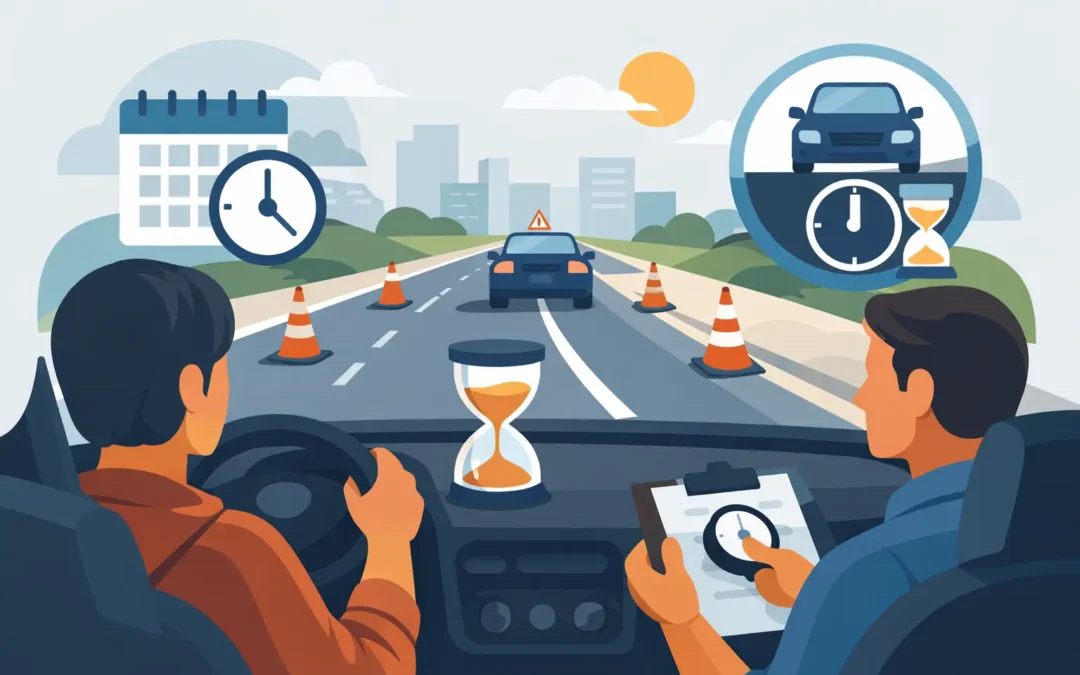
Most teens and parents ask the same question right after getting a permit: how long is behind the wheel training, really? The short answer in California is six hours with a professional driving instructor for teen drivers under 18. But the real timeline depends on how those hours are scheduled, how quickly the student builds confidence, and how soon the family wants to move toward the DMV drive test.
For many families, the bigger issue is not just the state minimum. It is figuring out how long the full process takes from permit to license, and what kind of lesson plan makes that process safer and less stressful. That is where understanding the details matters.
How long is behind the wheel training in California?
In California, teens under 18 must complete six hours of professional behind-the-wheel driver training with a DMV-licensed driving school. Those six hours are usually split into three separate two-hour lessons. This is the standard format because it gives students time to practice, absorb feedback, and return to the next lesson better prepared.
That six-hour requirement is only the professional training portion. It does not replace the additional supervised practice teens must complete with a parent, guardian, or other qualified adult. California also requires 50 hours of supervised driving practice, including 10 hours at night, before a teen can take the driving test.
So if you are asking how long is behind the wheel training, the legal minimum with an instructor is six hours. If you are asking how long it takes to become road-test ready, the answer is usually much longer.
What the 6-hour requirement actually includes
Professional in-car training is meant to build real driving skills in a structured way. A quality lesson plan usually starts with the basics, then moves into busier streets, lane changes, intersections, parking, and defensive driving habits. As the student improves, lessons may also cover more advanced situations like left turns in traffic, residential hazard awareness, and DMV test routes.
Two hours can go by quickly in a car. By the time an instructor reviews the lesson, gets the student settled, and works through several skill areas, the session is often packed. That is one reason the state minimum should be viewed as a foundation, not a guarantee that every teen will feel fully prepared after exactly three lessons.
Some students are calm and coachable from day one. Others need more time before they are comfortable merging, judging speed, or handling complex intersections. That difference is normal.
Why lessons are usually split into three sessions
Three two-hour lessons tend to work well for teen drivers because they balance instruction with retention. New drivers can get overloaded if too much is introduced at once. Breaking training into separate sessions gives them time to practice with a parent between lessons and come back ready for the next step.
This spacing also helps instructors identify patterns. A student may steer well in the first lesson but struggle with scanning at intersections. By lesson two or three, the instructor can revisit that weak point and track progress. That kind of structure is one of the biggest benefits of professional training.
For parents, this format also makes scheduling easier. Instead of blocking out a full day, families can fit lessons around school, sports, and work.
The minimum training time versus the real-world timeline
A teen can technically complete the required six hours in a fairly short window if lesson availability is open. Some students finish their three lessons within a few weeks. Others spread them out over a month or longer because of school schedules, family logistics, or availability.
But finishing the professional requirement is only one checkpoint. California teens must also hold their permit for at least six months before taking the road test. During that time, they should continue practicing in different conditions, not just repeat the same neighborhood route.
That means the answer to how long is behind the wheel training depends on what you mean:
- Professional lesson requirement: 6 hours
- Common lesson format: 3 lessons of 2 hours each
- Permit-holding period before the drive test: at least 6 months for teens under 18
- Total supervised practice required: 50 hours, including 10 at night
This is why parents should think beyond the minimum. The fastest legal route is not always the best route if the student still lacks confidence or consistency.
What can make behind-the-wheel training take longer?
Several factors can extend the timeline. The first is scheduling. During busy periods, especially summer and school breaks, lesson slots can fill quickly. Booking early helps families stay on track.
The second is student readiness. A teen who has never been behind the wheel may need the first lesson just to get comfortable with vehicle control, mirrors, turns, and braking. Another student may start with stronger basics and move faster.
Practice between lessons also matters. Teens who drive regularly with a parent usually progress more quickly than those who only drive during instructor sessions. The professional lessons give direction, but repetition at home builds muscle memory.
Then there is test readiness. Some students complete the required six hours but still benefit from extra instruction before the DMV road test. That is especially true if they need help with parking, lane positioning, speed control, or nerves behind the wheel.
When extra lessons make sense
Not every student needs more than the state minimum, but many do benefit from additional training. That is not a sign of failure. It is often the smarter and safer choice.
Extra lessons can help if a teen is anxious in traffic, struggles with judgment at intersections, or has not practiced consistently at home. They are also useful when the DMV test is approaching and the student needs a focused review of common test skills.
For busy parents, extra professional lessons can also reduce stress. Instead of trying to teach every detail on limited time, families can rely on a DMV-licensed instructor to cover the technical points clearly and consistently.
This is one reason package-based training works well. It gives families a structured path instead of leaving them to guess whether the teen is ready.
How to finish training efficiently without rushing
The best way to move through training efficiently is to start with a clear plan. Book lessons early, leave time between sessions for home practice, and keep the student driving regularly after each lesson. Even short practice drives can help if they include different skills and traffic conditions.
It also helps to treat each lesson as part of a progression. After the first session, focus on basic turns, stops, and lane control. After the second, work on traffic awareness, lane changes, and parking. After the third, practice with the DMV test in mind.
Families often save time when they choose a school that specializes in teen training and offers straightforward scheduling. If DMV test support is available, that can simplify the final step even more by reducing the pressure of arranging a vehicle and transportation on test day.
What parents should look for in a driving school
If you are comparing options, do not focus only on the number of hours. The quality of instruction matters just as much as the schedule. A DMV-licensed school with screened instructors, clear lesson packages, and experience working specifically with teens will usually provide a smoother experience.
Parents should also look for strong communication, transparent pricing, and practical convenience. The easier it is to enroll, schedule, and plan the next step, the more likely the student is to stay on track.
For families in North Orange County and nearby communities, a school like Teen Driving Academy can make that process simpler by combining teen-focused instruction, local service, and practical support around the licensing journey.
A realistic answer for teens and parents
So, how long is behind the wheel training? In California, the professional requirement for teens is six hours. In most cases, that means three two-hour lessons with a licensed instructor. But the full road to a license takes longer because teens must also complete supervised practice and hold the permit for six months.
The smartest approach is to aim for more than just checking a box. Good training should help a teen become calm, capable, and prepared for real traffic, not just the DMV test. When the process is structured well from the start, families usually save time, reduce stress, and feel much more confident about what comes next.
If your teen is ready to begin, the best next step is simple: start early, choose a licensed school, and build a lesson plan that fits both the law and your teen’s pace.