
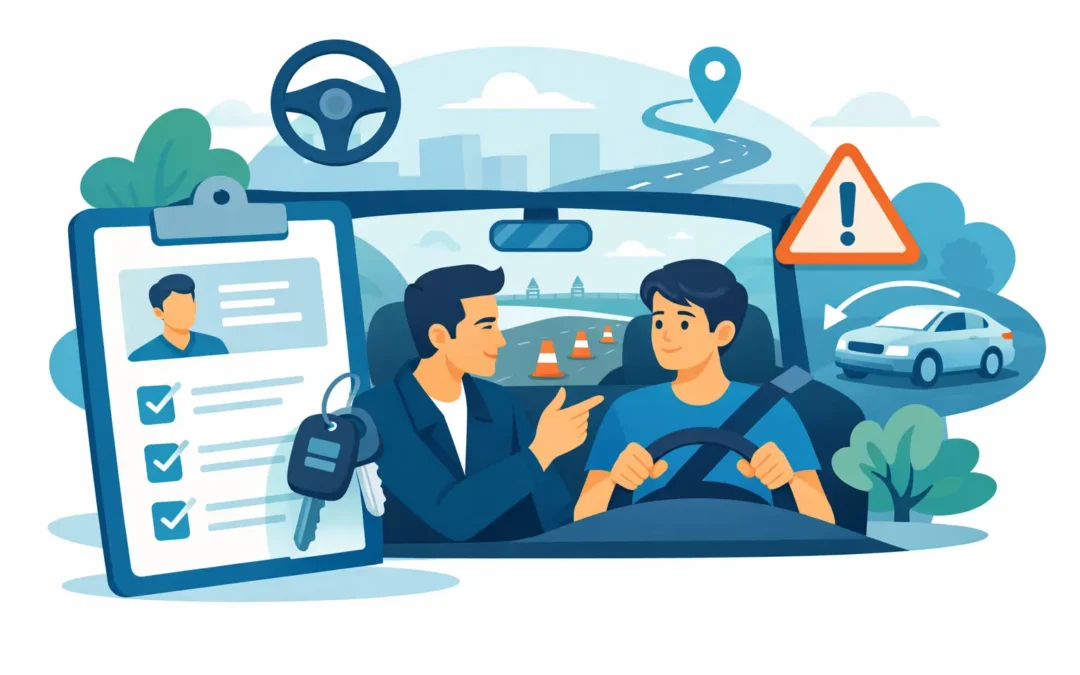
A teen with a permit does not need more random practice. They need permit holder driving lessons that turn nervous first drives into steady, repeatable skills. For most families, that means finding a structured way to build confidence, meet California requirements, and avoid the bad habits that show up when practice is inconsistent.
Why permit holder driving lessons matter
The first few months behind the wheel shape everything that follows. If a new driver learns how to scan intersections, manage speed, check mirrors, and respond to real traffic early, those habits tend to stick. If they learn to brake late, turn too wide, or guess through lane changes, those habits stick too.
That is why professional lessons are different from casual family practice. A parent can offer valuable seat time, but a trained instructor brings a system. Lessons usually follow a progression, starting with the basics and moving into lane control, residential driving, major streets, parking, freeway exposure when appropriate, and road test preparation. That structure helps teens improve faster because each lesson builds on the last.
For parents, there is another benefit. Teaching your own teen to drive can be stressful, especially when you are trying to correct mistakes in real time. Professional instruction reduces that pressure and gives families a clearer path forward.
What California permit holders actually need
In California, teens must complete driver education, receive a learner’s permit, and complete behind-the-wheel training before moving on to the license test. Requirements can change, so families should always confirm current DMV rules, but the basic process is straightforward.
Once a teen has a permit, behind-the-wheel training becomes the next major step. This is where many families get stuck. They know practice is required, but they are not always sure how to begin, how often to schedule lessons, or what should be covered first.
The answer depends on the student. A very nervous beginner may need a slower start focused on vehicle control, simple turns, and low-traffic streets. A teen who already understands the basics may be ready for a more direct path into traffic management, lane changes, parking, and test preparation. Good permit holder driving lessons adjust to the student while still covering the skills needed for safe, legal driving.
What happens during permit holder driving lessons
The best lessons are not just supervised driving. They are coached driving. That means the instructor is actively watching, correcting, and explaining what the student should do before, during, and after each traffic situation.
A typical early lesson may cover adjusting mirrors and seating position, smooth braking, steering control, right and left turns, stopping at limit lines, scanning for hazards, and understanding how to manage space around the car. Later lessons usually build toward lane changes, backing, curb parking, busier intersections, and defensive driving in more complex traffic.
Road test prep usually comes near the end, but it should not be the only goal. A student who learns only how to pass the test may struggle once they are driving alone. A stronger program teaches test skills and real-world safety at the same time.
Skills that should improve with each lesson
A permit holder should become more consistent, not just more comfortable. Confidence matters, but confidence without control is risky. After several lessons, students should show better judgment at intersections, smoother speed control, stronger awareness of signs and markings, and fewer reminders from the instructor.
Parents should also expect progress in decision-making. New drivers often know the rule but hesitate when they need to apply it in traffic. Repetition with professional coaching helps close that gap.
How many lessons does a permit holder need?
There is no single answer because every student starts at a different level. Some teens need more support with anxiety and basic coordination. Others learn quickly but still need help refining observation, timing, and defensive habits.
In general, fewer lessons may work for a student who gets regular, high-quality practice at home between sessions. More lessons make sense for families with busy schedules, limited access to a practice vehicle, or a teen who needs extra time to feel ready. Bundled lesson packages are often the most practical option because they create a clear training plan instead of leaving families to schedule one lesson at a time.
This is also where convenience matters. If a school offers simple scheduling, organized packages, and DMV test support, it can save parents a great deal of time. For working families, that convenience is not a bonus. It is often the reason the process gets finished on time.
How to choose the right school for permit holder driving lessons
Not all driving schools offer the same value. Price matters, but it should not be the only factor. A cheaper lesson is not a better deal if the instruction is rushed, inconsistent, or poorly organized.
Start with legitimacy. The school should be DMV licensed, and instructors should be properly screened and trained. That protects families and signals that the program is operating to California standards.
Then look at experience. A school that has worked with thousands of teen drivers usually has a better handle on the common issues permit holders face, from first-lesson nerves to road test preparation. Experience also tends to show up in smoother operations, clearer scheduling, and more realistic guidance for parents.
You should also pay attention to how the school explains its services. Clear package options, transparent pricing, and simple enrollment are all good signs. If the process feels confusing before the first lesson, it may not get easier later.
Good instruction should feel structured
A strong instructor is calm, direct, and specific. They do not just say, be careful. They explain what to watch for, when to brake, where to position the car, and how to correct mistakes. Teens learn best when feedback is immediate and practical.
Parents should feel that structure too. It helps when the school can explain what was covered, what still needs work, and what the next lesson should focus on. That kind of communication makes home practice more useful.
The parent role between lessons
Professional lessons work best when they are supported by steady practice at home. That does not mean every parent needs to teach advanced driving techniques. It means helping the student repeat what they already learned with an instructor.
Short, regular practice sessions are usually more effective than occasional long drives. A teen who practices turns, stops, parking, and scanning several times a week will usually improve faster than one who drives once in a while for an hour. Consistency beats intensity.
Parents should also avoid changing the method too much. If the instructor has taught a certain scanning routine, parking approach, or lane change sequence, it helps to reinforce that same system. Mixed messages slow progress and frustrate students.
When a permit holder is ready for the road test
Readiness is not just about checking boxes. A student should be able to drive with fewer reminders, stay calm in common traffic situations, and recover from minor mistakes without panicking. They should understand the rules, but more importantly, they should apply them in real time.
Road test support can make a real difference here. Some families prefer using the training vehicle for the test because the student already knows the car and feels more comfortable in it. Transportation to the DMV can also remove one more logistical problem from an already busy day.
For families in North Orange County and nearby communities, this kind of support is often what makes the final step feel manageable. Teen Driving Academy has built its programs around that reality, with teen-focused training, practical packages, and services designed to reduce stress for both students and parents.
Why the cheapest option is not always the best one
When families compare schools, it is tempting to focus only on the lowest upfront cost. But driving lessons are not a commodity. The real value comes from qualified instruction, safe habits, efficient progress, and fewer delays.
A school with experienced instructors, strong scheduling, and a clear training path can help a teen become test ready with less wasted time. That often means better value overall, even if the initial price is not the lowest on the page.
The same is true for bundled services. If a package includes lessons, road test preparation, and DMV test support, it may solve multiple problems at once. For busy parents, that kind of simplicity can matter as much as the lesson count.
Permit holder driving lessons are really about building a safe driver before the license is issued, not after. When the training is structured, professional, and easy to follow, teens gain more than practice hours. They gain a better start, and parents get a process they can actually trust.