
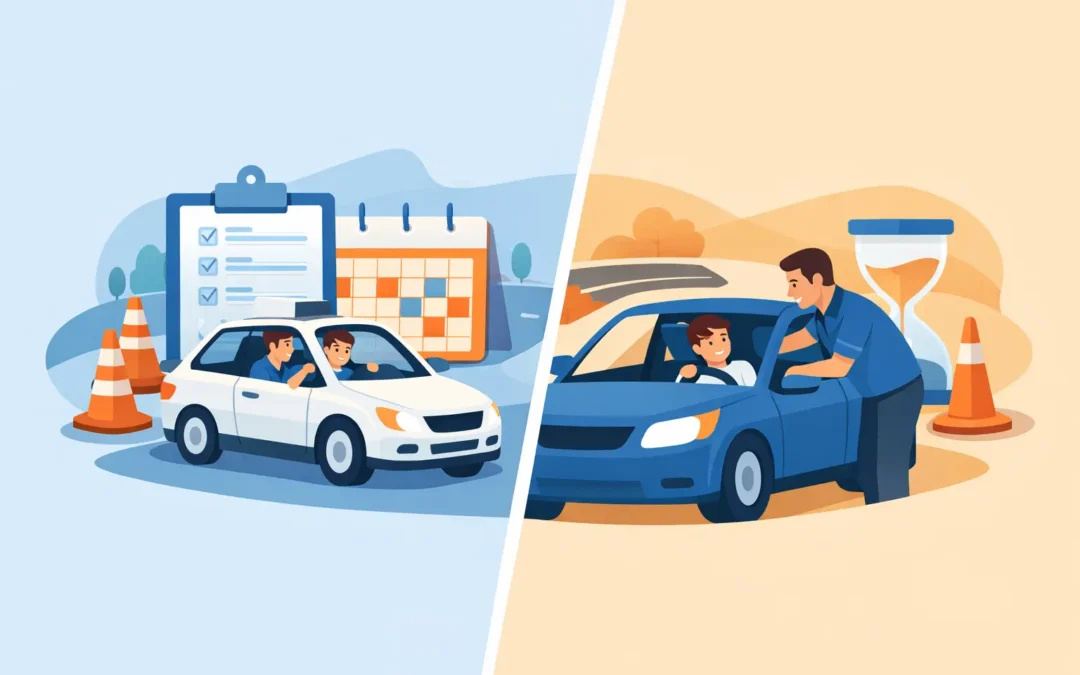
A driving school package vs single lessons decision can affect more than the total cost of training. For California teens, the right choice can make it easier to complete required behind-the-wheel instruction, build skills in the proper order, and stay on track for the DMV road test. For parents, it can also mean fewer scheduling headaches and a clearer plan from permit to license.
The best option depends on where your teen is in the licensing process, how much practice they have already completed, and whether your family needs a structured training plan or occasional professional support. Both options can be valuable when they are chosen for the right reason.
What Is Included in a Driving School Package?
A driving school package combines a set number of behind-the-wheel lessons into one enrollment. Depending on the package, it may also include online driver’s education, permit preparation, road test practice, DMV transportation, or use of the school vehicle for the driving test.
For a new permit holder, a package creates a defined path. Lessons are typically scheduled to build on one another, starting with vehicle controls, turns, lane position, and neighborhood driving before moving into busy intersections, parking, freeway driving, and mock road test routes.
California requires teens under 18 to complete six hours of professional behind-the-wheel training with a DMV-licensed instructor. A package that includes the required lessons helps families meet that requirement without having to purchase each session separately or track what remains.
Packages are often the strongest fit for teens who are beginning with little or no driving experience. They give the instructor time to see how the student progresses over multiple lessons and reinforce the skills that need more attention.
Why structure matters for first-time drivers
Driving is not learned in one or two sessions. A teen may understand a three-point turn during the first lesson but still need more time with scanning, speed control, right-of-way decisions, and changing lanes in real traffic.
A lesson sequence gives students room to make mistakes, receive clear feedback, and return to the same skill later with more confidence. That progression is especially helpful for teens who feel nervous behind the wheel or have not had consistent practice with a parent or guardian.
When Single Driving Lessons Make Sense
Single lessons are purchased one session at a time. They are useful when a student has a specific need rather than a full training plan.
For example, a permit holder may already have completed California’s required professional instruction but want one additional lesson before the road test. Another teen may need help with parking, freeway merging, left turns at busy intersections, or correcting habits picked up while practicing at home.
Single lessons can also work well for families with unpredictable schedules. If sports, school activities, work commitments, or travel make it difficult to plan several appointments at once, booking as needed can offer more flexibility.
The trade-off is that single lessons can become less organized over time. Without a set plan, families may wait too long between sessions, lose track of which skills have been covered, or realize close to the road test that their teen needs more practice than expected.
Driving School Package vs Single Lessons: The Key Differences
The main difference is not simply how lessons are purchased. It is the level of planning behind the training.
A package is designed for families that want a clear starting point, a defined number of lessons, and a structured route toward the license. It may offer better overall value when a teen needs multiple sessions, particularly if driver’s education or DMV test support is included. It also makes it easier to schedule lessons early, before the calendar fills up.
Single lessons offer more control over timing and quantity. They can be a practical choice for a teen who needs targeted support, has substantial supervised driving experience, or only wants a professional evaluation before the DMV test.
Neither option automatically guarantees readiness. A teen still needs regular supervised practice outside of professional lessons. California’s provisional licensing rules require extensive practice with a parent, guardian, or another qualified adult, including nighttime driving. Professional instruction teaches technique and safety awareness, while home practice helps those skills become natural.
How to Choose the Right Option for Your Teen
Start by looking honestly at your teen’s current experience. A student who has just received a permit usually benefits from a package because there is more to learn than basic steering and stopping. They need repeated exposure to different traffic situations, careful coaching, and a plan that meets state requirements.
A teen who has been practicing consistently for months may need fewer professional sessions. In that situation, a single lesson can identify whether the student is truly ready for the DMV road test or still needs work in a few key areas.
Parents should also consider scheduling. If you know your teen will need the required six hours of instruction, enrolling in a package early can reduce last-minute pressure. Lessons must be spaced appropriately, and road test appointments can be difficult to coordinate during busy periods. Waiting until a permit is close to expiration may limit your choices.
Budget matters as well, but the lowest upfront price is not always the best value. Compare what is actually included: the number and length of lessons, instructor qualifications, pickup and drop-off availability, online driver’s education, and road test services. A package with services your family will use may be more practical than purchasing several separate sessions later.
Questions Parents Should Ask Before Enrolling
Before choosing either option, make sure the school can explain the training plan clearly. Ask whether instructors are DMV-licensed and screened, how lesson progress is documented, and what happens if your teen needs extra help with a particular skill.
It is also smart to ask about the service area and pickup procedures. For families in North Orange County communities such as Anaheim, Fullerton, Brea, Yorba Linda, and Placentia, local availability can make a meaningful difference when trying to fit lessons around school and work.
If your teen is approaching the road test, ask whether the school offers a DMV test service. Transportation to the DMV and use of a properly equipped training vehicle can remove a major source of stress, especially for families that do not have a suitable vehicle available on test day.
A Practical Path From Permit to Road Test
For most new teen drivers, the simplest approach is to enroll in a package that covers the required professional training and schedule lessons early in the permit period. Between lessons, practice the same skills with a qualified adult. Keep drives varied: quiet residential streets are helpful at first, but teens also need experience with larger intersections, parking lots, lane changes, nighttime conditions, and heavier traffic.
As the road test gets closer, a focused single lesson can still be useful, even for students who started with a package. A final professional assessment can catch small issues that parents may not notice, such as incomplete stops, late signaling, poor mirror checks, or hesitation at uncontrolled intersections.
Teen Driving Academy has helped local families navigate this process since 1990, with teen-focused instruction and options that support both required training and DMV test preparation. The goal is not to rush a student to the finish line. It is to help them arrive prepared, calm, and capable of making safe decisions after the license is issued.
Choose the option that gives your teen enough instruction, enough practice, and enough time to develop good habits. A driver’s license is the milestone, but safe independent driving is the result that matters most.