
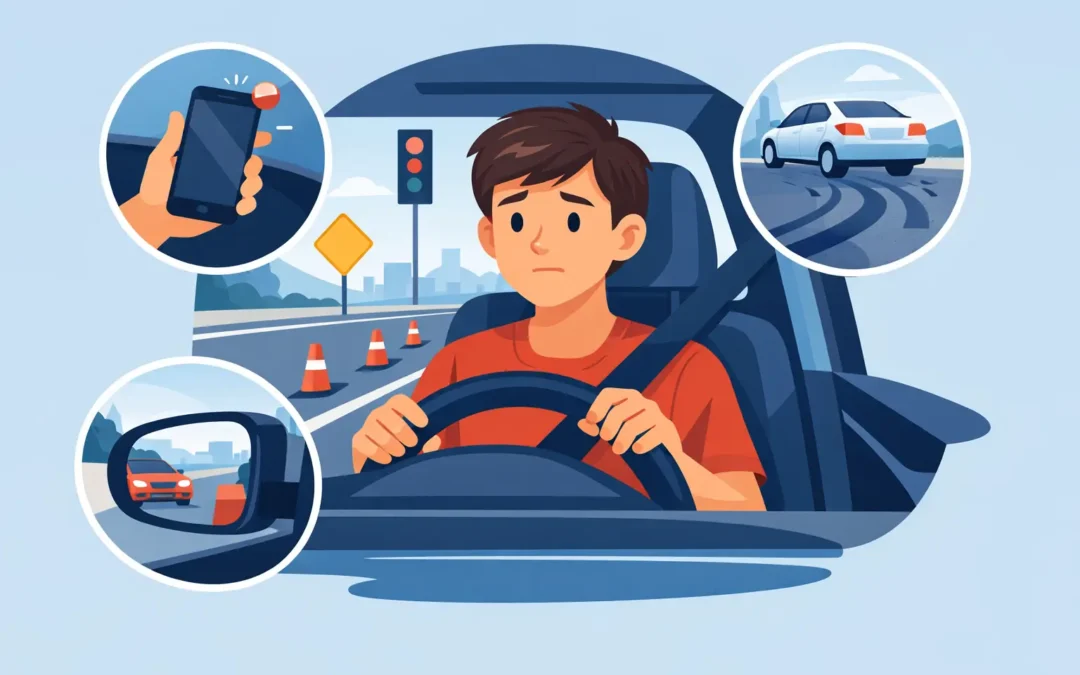
A road test can be over in minutes, but the habits behind it are built over many drives. The top teen driving mistakes to fix are rarely dramatic. More often, they are small repeat errors: a rushed stop, a late mirror check, a turn taken too wide, or a decision made because another driver is waiting. Correcting those patterns early helps teens drive more safely and feel far more prepared for the California DMV road test.
The top teen driving mistakes to fix before the DMV test
Rolling through stop signs
A stop sign requires a complete stop, not a slow crawl. The vehicle should come to a full stop behind the limit line, crosswalk, or intersection edge. A good habit is to pause long enough to feel the vehicle settle, then check left, right, and left again before moving forward.
Teens often roll because they are focused on what comes next: turning, watching traffic, or avoiding holding up cars behind them. But drivers waiting behind you do not decide whether it is safe to proceed. Taking the extra moment is the right choice every time.
Missing mirror and shoulder checks
Mirrors tell a driver what is behind the vehicle, but they do not show every area beside it. Before changing lanes, pulling away from a curb, merging, or moving around a cyclist, teens need a clear mirror check and a quick shoulder check for the blind spot.
The common problem is not that a teen has never learned this step. It is that the step becomes rushed or skipped when traffic feels busy. Practice saying the sequence quietly at first: mirror, signal, shoulder check, move when clear. With repetition, it becomes a natural routine instead of something remembered only during a driving lesson.
Turning from the wrong position
Wide turns, cutting corners, and entering the wrong lane are frequent road test issues. For a right turn, approach close to the right side of your lane and finish in the nearest legal lane. For a left turn, enter the intersection correctly and complete the turn into the lane closest to the center line, unless markings or traffic conditions direct otherwise.
Speed matters here. A turn taken too quickly makes it harder to steer accurately, notice pedestrians, and react to changing traffic. Slow down before the turn, look through it, and accelerate only after the vehicle is straight and the path is clear.
Forgetting pedestrians, bikes, and crosswalks
New drivers can become so focused on cars that they miss the people sharing the road. At intersections, driveways, shopping centers, school areas, and residential streets, pedestrians may appear when a teen is preparing to turn. Bicyclists can also be harder to judge because they move faster than walkers but are less visible than vehicles.
Before every turn, scan the crosswalk and sidewalk area. Do not assume a pedestrian will wait, even if they have not stepped into the street yet. In California, a careful driver expects people to be present and yields when required. This is both a safety habit and a strong sign of good judgment on the road test.
Driving too fast for conditions
The posted speed limit is the maximum legal speed under ideal conditions, not a target that must always be reached. Rain, glare, heavy traffic, parked cars, narrow residential streets, and limited visibility all call for more space and less speed.
Some teens also make the opposite mistake: driving so slowly that they disrupt traffic without a reason. The goal is to maintain a safe, predictable speed that matches the road and flow of traffic. If the limit is 35 mph and conditions are clear, driving 20 mph may create a different hazard. A professional instructor can help a permit holder learn when caution means slowing down and when it means keeping pace.
Following too closely
Tailgating usually starts with a false sense of control. A teen may believe they are paying attention, so they can stop quickly if needed. The problem is that braking distance is only part of the picture. Drivers also need time to see a problem, decide what to do, and respond.
Use at least a three-second following distance in normal, dry conditions. Pick a fixed object ahead, such as a sign or pole. When the vehicle in front passes it, count one thousand one, one thousand two, one thousand three. If your vehicle reaches that point before the count ends, increase the gap. Add more space at night, in rain, or when traffic is unpredictable.
Hesitating when it is safe to go
Caution is valuable. Excessive hesitation is different. Stopping when there is no stop sign, waiting too long at an open intersection, or passing up multiple safe gaps can confuse other drivers. DMV examiners look for safe decisions, but they also expect a driver to recognize a reasonable opportunity and proceed confidently.
This is especially noticeable at four-way stops, left turns, and right turns into traffic. The solution is not to force a gap. It is to build better judgment through repeated practice in progressively busier situations. Start with quieter streets, then work up to busier intersections with an instructor or experienced supervising driver.
Poor lane control and drifting
A vehicle that wanders within its lane can make passengers nervous and create real risk near parked cars, cyclists, or adjacent traffic. Many teens drift because they stare directly over the hood or keep checking mirrors for too long.
Look farther down the road. Your hands naturally guide the vehicle toward where your eyes are focused. Keep both hands positioned for control, make small steering adjustments, and avoid gripping the wheel so tightly that every correction becomes exaggerated. When checking mirrors, glance briefly and return your eyes to the road ahead.
Letting distractions take over
For teen drivers, phones are an obvious distraction, but they are not the only one. Changing music, responding to friends in the car, eating, searching for directions, or arguing with a passenger can pull attention away from the driving task. A few seconds of distraction at city speed covers a surprising amount of roadway.
Set up navigation and music before shifting into drive. Put the phone away, even if it is only being used for a quick message at a red light. For new drivers, a quiet car is often the best practice environment. As skill and confidence grow, teens can learn to manage normal driving distractions without treating the vehicle like a social space first.
Not preparing for the test vehicle
A teen can drive well and still start a DMV test at a disadvantage if they do not know the vehicle. Before the appointment, locate the headlights, turn signals, windshield wipers, defroster, parking brake, and hazard lights. Check that the vehicle has valid registration, insurance, and working lights.
Practice in the same vehicle whenever possible. Different cars brake, turn, and accelerate differently, and an unfamiliar vehicle can make basic maneuvers feel harder than they need to be. Families who do not have a suitable test vehicle or want extra support may also consider a school service that provides transportation and a training vehicle for the DMV road test.
Build correction into every practice drive
The fastest way to improve is not simply to drive more miles. It is to choose one or two skills for each practice session and review them afterward. For example, one drive might focus on complete stops and intersection scanning. The next can focus on lane changes, following distance, and smooth turns.
Ask specific questions after practice: Did I check for pedestrians before every turn? Did I leave enough room behind the car ahead? Did I signal early enough? Clear feedback helps a teen identify patterns without feeling criticized. It also gives parents a more productive way to support practice time.
Teen Driving Academy has worked with California teens and families since 1990, and one lesson remains consistent: confident drivers are not the ones who rush. They are the ones who see more, leave space, and make deliberate decisions. Start correcting one habit on the next drive, then keep building from there.