
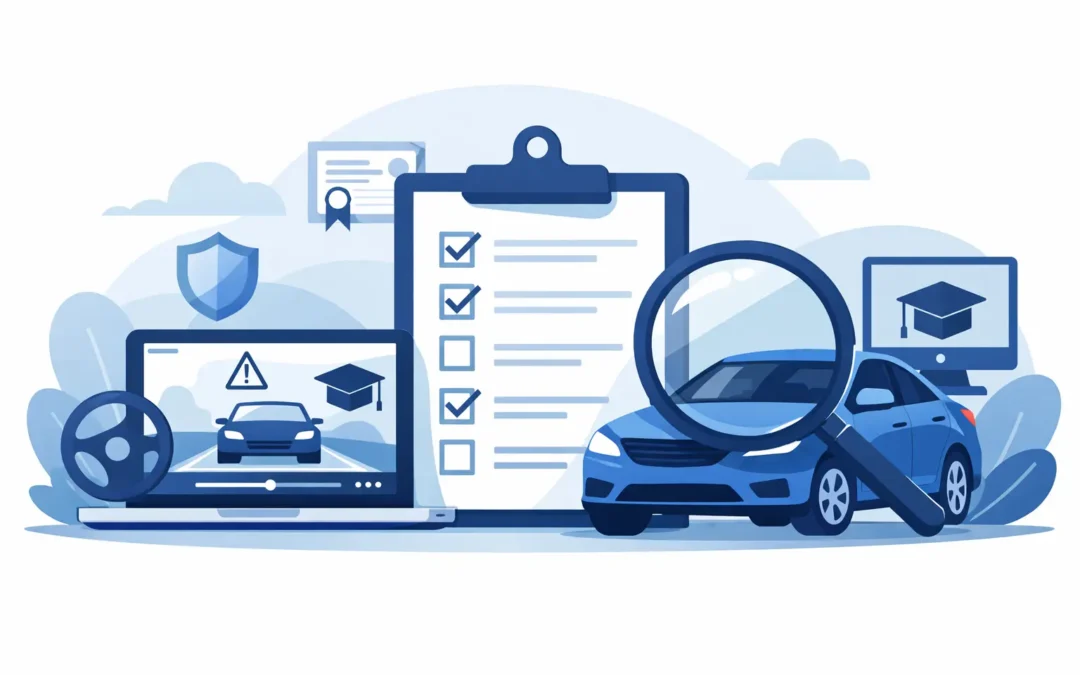
A low price and a polished website can make an online course look like an easy choice. But an online drivers ed course review should answer a more practical question: will this course help a California teen meet the education requirement, understand safe driving habits, and move confidently toward the learner’s permit?
For parents, the decision also affects the schedule, budget, and safety of a new driver. The right course should be legitimate, easy to complete at a teen’s pace, and clear about what happens after the final lesson. Before enrolling, look beyond the advertised price and check the details that affect the licensing process.
Start With California DMV Approval
For teens under 18, California requires driver education before they can receive a learner’s permit. The course must provide at least 30 hours of instruction and be offered by a DMV-licensed driver education provider. That is the first item to verify in any online driver’s ed course review.
A valid course should clearly identify its licensing information and explain that it meets California’s driver education requirement. If a provider is vague about licensing, promises a certificate without explaining eligibility, or makes the course sound like a shortcut around DMV rules, choose another option. Driver education is not just a quiz to pass. It is the classroom foundation for decisions a teen will make behind the wheel.
Also check how the completion certificate is handled. Teens need proof of completed driver education when applying for a permit, so parents should know whether the provider issues the certificate electronically, mails it, or provides instructions for presenting it to the DMV. A clear process prevents a last-minute problem at the permit appointment.
Review the Course Experience, Not Just the Price
Online driver education works well for many families because it can fit around school, sports, jobs, and other commitments. Still, flexibility only helps when the course itself is organized and easy to use.
Look for lessons that break California driving rules into manageable sections. A teen should be able to study topics such as signs and signals, right-of-way rules, freeway driving, distracted driving, sharing the road with cyclists, and the consequences of impaired driving without feeling buried in text. Video, visual examples, knowledge checks, and short lesson segments can make the material easier to retain.
Course access matters, too. Confirm that the student can sign in from a phone, tablet, or computer and return where they left off. A course that saves progress is far more practical for a teen who has only 20 minutes between homework and practice. Ask whether there are time limits to finish, whether the fee includes the final exam, and whether a parent can get help if an account issue comes up.
The cheapest option is not always the best value. A low-cost course that has confusing lessons, delayed support, or unclear certificate delivery can create more work than it saves. On the other hand, paying for features a teen will never use may not make sense either. The best fit is a course with straightforward pricing, dependable access, and support when a real question arises.
Questions Parents Should Be Able to Answer Before Enrollment
Before selecting a course, parents should be able to find direct answers to a few basics: Is the provider DMV licensed? Does the course meet the 30-hour California requirement? How long does certificate delivery take? What devices can the teen use? Is customer support available if there is an issue?
If those answers are hard to find before payment, getting help after enrollment may be just as difficult. A trustworthy provider makes the next steps visible from the start.
Check Whether the Material Teaches Real-World Safety
Passing a written knowledge test is one goal of driver education, but it should not be the only goal. Teen drivers need to understand why rules exist and how quickly a routine situation can change on the road.
A quality course should cover more than memorizing speed limits and sign shapes. It should explain safe following distance, scanning intersections, managing blind spots, dealing with aggressive drivers, handling rain and reduced visibility, and avoiding phone distractions. It should also address the risks that are especially relevant to inexperienced drivers, including peer passengers, overconfidence, and driving before they are rested.
California rules change from time to time, so current content is another useful sign. A course should reflect the latest guidance in the California Driver’s Handbook and avoid outdated examples that could confuse a student before the knowledge test.
Understand What Online Driver Education Does Not Include
An online driver education course is only one part of the path to a California license. It prepares a teen for the permit process and provides the required classroom education, but it does not replace behind-the-wheel instruction.
After receiving a learner’s permit, a teen under 18 must complete six hours of professional behind-the-wheel training with a licensed driving instructor. They also need 50 hours of supervised practice with a parent, guardian, or another qualified adult, including 10 hours of night driving. These requirements take time, which is why it often helps to think about online education and driving lessons as one connected plan.
Families should ask a simple scheduling question: once the teen completes the online course and gets a permit, how quickly can driving lessons begin? A course provider may be excellent at education but offer no practical support for lessons. That can be fine if a family already has a driving school selected. If not, a provider that can coordinate both education and in-car training may reduce gaps and confusion.
For families in North Orange County and nearby communities, Teen Driving Academy offers online driver education alongside DMV-licensed behind-the-wheel lessons. Having one local team for both parts can make it easier to track progress, schedule lessons, and prepare for the road test.
Consider Support for the DMV Road Test
The last stage of driver training can be stressful for both teens and parents. A student may have completed the online course, practiced for months, and still feel nervous about the road test. That is normal. What matters is whether the teen has had enough practice with lane changes, turns, parking, intersections, speed control, and the habits an examiner will observe.
Some driving schools offer road test preparation, transportation to the DMV, and use of a training vehicle for the test. This is not necessary for every family, but it can be a valuable option when a parent has a busy work schedule, the family vehicle is not available, or the teen is more comfortable testing in the car used for lessons.
Review these services carefully. Confirm what is included, how pickup works, whether a practice lesson is recommended before the test, and what happens if the DMV changes or cancels an appointment. Clear details matter because DMV testing day should feel organized, not rushed.
Use Reviews Carefully
Online reviews can reveal useful patterns, especially for customer service, scheduling, and certificate delivery. Read more than the star rating. A detailed review that mentions communication, instructor professionalism, or a resolved issue is more useful than a one-line comment.
At the same time, no school will be the perfect fit for every family. One teen may prefer self-paced study and a quiet instructor, while another may need more structure and frequent reminders. Look for consistent signs of reliability rather than expecting every review to say the same thing.
Pay close attention to how a company responds when something goes wrong. Delays can happen, especially around DMV appointments and busy seasons. A provider that communicates clearly and offers a practical solution is usually a better choice than one that makes broad promises but is difficult to reach.
Choose a Course That Makes the Next Step Clear
A good online drivers ed course review is not about finding the flashiest program. It is about confirming that the course is DMV compliant, understandable for a first-time driver, accessible on a real family schedule, and connected to a clear plan for permits, practice, and lessons.
Start with the provider’s credentials, then look at the student experience and the support available after completion. When teens know what to do next and parents know who to call, driver education becomes less of a paperwork task and more of what it should be: a steady first step toward safe, independent driving.