
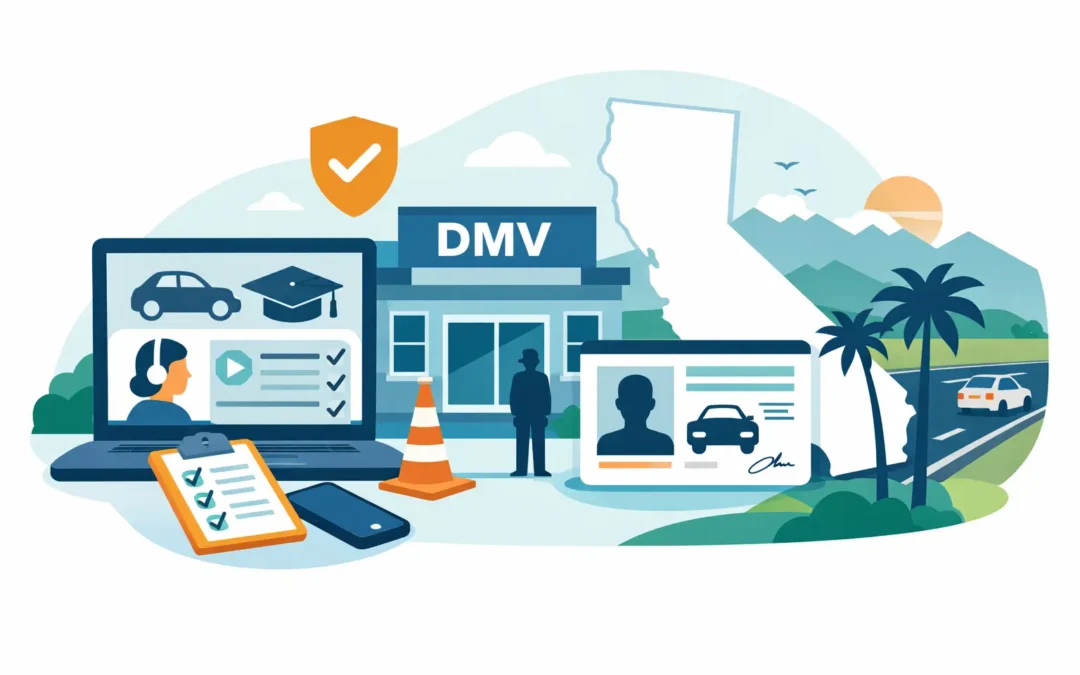
A slick website and a low price are not enough when your teen needs driver’s ed that actually counts. If you’re asking, is online drivers ed dmv approved, the short answer is yes – sometimes. In California, online driver’s education can satisfy the classroom education requirement for teens, but only if the course provider is licensed by the state and issues the right completion certificate.
That distinction matters more than most families expect. A course can look polished, promise fast completion, and still leave a student with nothing the DMV will accept. Before you enroll, it helps to know what approval really means, what documents matter, and where online driver’s ed fits into the larger licensing process.
Is online drivers ed DMV approved for California teens?
For California teens under 18, the DMV requires driver education before they can take the knowledge test for a learner’s permit. That driver education may be completed online, at home, or in a classroom setting. Online learning is allowed, but the provider must be licensed by the California Department of Motor Vehicles to offer driver education.
That is the key point. The DMV does not simply approve any course because it is online. Approval is tied to the school or provider being properly licensed and operating under California rules. When the course is legitimate, the student receives a Certificate of Completion of Driver Education, commonly known as the pink certificate or DMV form DL 400C. That certificate is what proves the requirement has been met.
So the practical answer is this: online driver’s ed can be DMV-approved in California, but only through a licensed provider that issues the correct certificate.
What DMV approved really means
Parents often use the phrase DMV approved as shorthand, but there are a few moving parts behind it. In California, driver education schools are regulated. A valid provider should be authorized to teach the required curriculum and issue the certificate teens need for permit testing.
This matters because some online courses are designed for adults, some are traffic school, and some are aimed at drivers in other states. Those may be useful in some context, but they do not automatically meet California’s teen driver education requirement.
A California teen course should be built specifically for first-time drivers working toward a learner’s permit. It should cover the state-required material, track completion properly, and provide the certificate after the student finishes all required sections and passes the course requirements.
How to tell if an online course is legitimate
The safest approach is to verify the provider before paying. A valid school should clearly state that it is licensed by the California DMV. That information should not be hidden in fine print or left vague.
You should also check whether the course is specifically for teen driver education, not traffic violator school or a mature driver program. Those are completely different services. If the site talks generally about driving courses without clearly saying it meets California teen permit requirements, that is a reason to pause.
Another good sign is a clear explanation of the completion certificate. If the provider does not mention the certificate teens need after finishing the course, that is a red flag. Families should know upfront what document they will receive and how it will be delivered.
Price can also tell you something, but not always in the way people think. A low-cost course is not automatically bad, and a high-priced one is not automatically better. What matters is whether the school is licensed, established, and set up to support students if they have questions or technical issues.
Where online driver’s ed fits in the California licensing process
Online driver’s education is only one step. For teens under 18, California’s licensing path includes several requirements, and online coursework does not replace the rest of them.
First, the student completes a state-licensed driver’s ed course. After finishing, they receive the completion certificate. They then take that proof to the DMV when applying for a learner’s permit and taking the written knowledge test.
After getting the permit, the student must complete the required behind-the-wheel training with a licensed driving school. In California, that includes six hours of professional in-car instruction. They also need supervised practice driving with a parent, guardian, or other qualified adult before they can take the road test.
This is where some confusion happens. A parent may ask whether an online course is enough. It is enough for the education portion, if it is from a licensed provider. It is not enough for the full licensing process.
Why families choose online driver’s ed
For many teens and parents, online learning is the most practical option. It removes the need to drive to a classroom, work around fixed schedules, or wait for the next in-person session to begin. A teen can start quickly, move through the lessons at an appropriate pace, and study from home.
That convenience is especially helpful for busy families balancing school, sports, work, and other commitments. In communities across North Orange County, many parents want a path that is compliant and efficient without adding more scheduling stress.
Online driver’s ed also works well for students who learn better when they can pause, reread, and review material on their own time. A classroom can be helpful for some learners, but for others, the flexibility of online instruction leads to better retention.
The trade-off is that online learning requires self-discipline. A teen still has to pay attention, complete all required sections, and take the material seriously. Fast access is useful, but rushing through the course without absorbing the content does not prepare a new driver for real traffic situations.
Questions parents should ask before enrolling
A little screening on the front end can prevent problems later. Ask whether the school is licensed by the California DMV. Ask if the course is specifically for teens under 18 seeking a California learner’s permit. Ask what certificate will be issued at completion and how long it takes to receive it.
It is also smart to ask what support is available if your teen has trouble accessing the course or understanding the material. Some schools offer straightforward enrollment and responsive help, while others are hard to reach once payment is made.
If you know your teen will also need behind-the-wheel lessons, look at the bigger picture. Choosing a school that offers both online education and in-car training can make the process easier. It keeps the paperwork more organized and gives families one point of contact as the student moves from permit prep to driving lessons and eventually the road test.
Common mistakes to avoid
One common mistake is assuming all online driver’s ed is the same. It is not. California teen driver education has specific rules, and out-of-state or non-licensed courses may not count.
Another mistake is waiting until the DMV appointment is already booked to verify the certificate. If there is a problem with the provider or the course completion record, that timing can create delays.
Families also sometimes focus only on getting the permit as fast as possible. The permit matters, but the bigger goal is safe driving. A quality program should help teens understand rules of the road, risk awareness, and responsible decision-making, not just help them pass a test.
Choosing a course with confidence
If you are evaluating options, look for a provider that is clear, established, and specific about California compliance. The school should explain exactly what the course covers, who it is for, and what happens after completion. Simple enrollment, transparent pricing, and clear next steps are all good signs.
Experience matters too. A school that has worked with teen drivers for years usually has a better sense of where students struggle and what parents need. That can make a real difference when your family wants a smooth start, especially if you plan to continue into behind-the-wheel lessons and DMV test preparation. Teen Driving Academy, for example, focuses on exactly that kind of structured path for California teens and their parents.
The best course is not just the one that is accepted. It is the one that helps your teen start with the right information, the right documentation, and the right support. When a provider is properly licensed and set up for California teens, online driver’s ed can be a convenient and reliable first step toward the permit.