
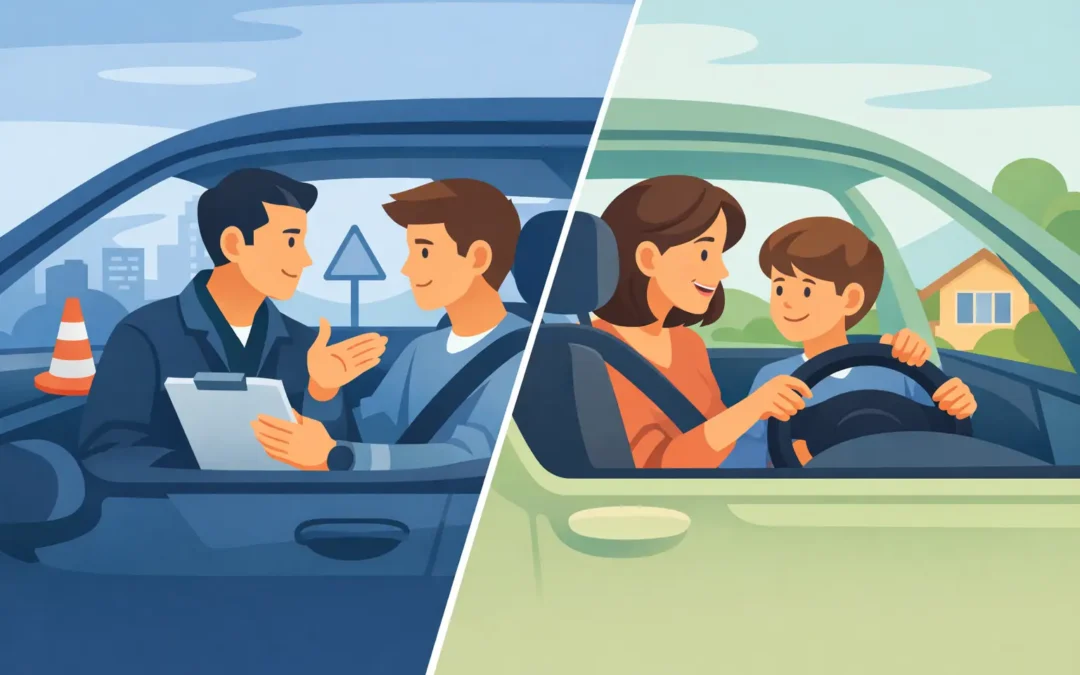
A lot of families ask the same question right after a teen gets a permit: should we handle the driving practice ourselves, or pay for professional instruction? When it comes to private driving lessons vs parent teaching, the right answer is rarely all one or the other. It depends on your teen’s confidence, your schedule, your patience, and how much structure you want built into the process.
For many California families, the real goal is not just checking a box for training hours. It is helping a new driver become safe, calm, and road-ready without turning every practice session into an argument. That is where the difference between a parent-led approach and private lessons becomes very clear.
Private driving lessons vs parent teaching: what changes?
The biggest difference is structure. A parent usually teaches based on daily opportunities. You might practice in a parking lot on Sunday, drive to school during the week, and work on turns or lane changes as situations come up. That can work well, especially when the parent is calm, experienced, and available.
Private driving lessons are usually more deliberate. A professional instructor follows a progression. The teen starts with core vehicle control, then moves into lane positioning, intersections, residential driving, traffic management, freeway skills, parking, and test preparation. Instead of hoping the right lessons happen naturally, the training is organized from the start.
That structure matters because teens are learning more than how to move a car. They are learning how to scan ahead, predict hazards, recover from mistakes, and make decisions under pressure. Those skills are easier to teach when the instructor is trained to spot gaps and correct them early.
Where parent teaching works well
Parent teaching has real strengths, and many teens benefit from it. First, it is familiar. A teen may feel more relaxed with a parent than with a new instructor. That comfort can help in the earliest practice sessions, especially if the student is nervous.
Second, parents can give teens more seat time. Professional lessons happen in scheduled blocks, but parents can add frequent short drives that build repetition. Backing out of the driveway, driving to practice, stopping at four-way intersections, or parking at the grocery store all add up.
There is also the cost factor. For families trying to manage expenses, parent teaching is the lower-cost option. If a parent has the time and the teen is progressing well, this approach can cover a lot of the required practice.
Parent teaching works best when the parent is patient, consistent, and willing to teach current safe-driving habits rather than relying only on personal habits built over decades. It also works best when the teen responds well to coaching from that parent. Not every teen does.
Where parent teaching gets hard
The challenge is that being a good parent and being a good driving instructor are not the same job. Many parents know how to drive safely, but teaching that skill in a clear, step-by-step way is different.
A common issue is stress. Parents are emotionally invested, and teens can feel that immediately. A small mistake like braking late or turning too wide may trigger panic in the passenger seat. The teen tenses up, the parent raises their voice, and the lesson stops being productive.
Another issue is inconsistency. One parent may insist on one technique, while another teaches something different. Even when the advice is well meaning, mixed messages can confuse a beginner.
Parents also tend to overlook habits because they are so used to driving. They may not explain mirror checks, speed control, following distance, blind spot checks, or scanning patterns in a way a teen can actually apply. They know what feels right, but they may not break it down in a teachable way.
What private driving lessons offer
Private lessons bring objectivity. The instructor is not reacting as a parent. They are watching for patterns, correcting them, and keeping the car environment focused on learning instead of emotion.
That can be a major benefit for both teen and parent. Many students actually listen better to a professional because the feedback feels less personal. When an instructor says, “Check your blind spot earlier” or “Slow down before the turn,” it lands as coaching, not criticism.
Professional instruction also helps with completeness. A licensed instructor is trained to cover the skills a teen needs for both daily driving and the road test. That includes areas some families avoid, such as unprotected left turns, busy intersections, freeway entries, lane changes in traffic, and defensive driving techniques.
There is also accountability. A good lesson plan shows what the student has practiced, what still needs work, and how ready they are for the next step. That clarity helps families avoid guessing whether a teen is truly prepared.
Safety and confidence are not the same thing
A teen can feel confident and still be underprepared. This is one reason private driving lessons vs parent teaching is such an important comparison.
Parents often see improvement and assume the teen is almost ready. The student can start, stop, turn, and park reasonably well, so it feels like enough. But safe driving is really about judgment. Can the teen manage pressure from other drivers? Can they identify a stale green light, anticipate a pedestrian stepping off the curb, or adjust smoothly when traffic changes fast?
Professional instructors are trained to measure those decision-making skills, not just basic car control. That outside evaluation can prevent families from moving too fast.
At the same time, private lessons alone are usually not enough practice. Most teens still need parent-supervised driving between lessons to build comfort and repetition. That is why the strongest path is often a combination, not a choice between extremes.
Cost matters, but so does efficiency
It is fair to compare cost. Parent teaching looks cheaper upfront, and in many cases it is. But cost should be weighed against time, stress, and the risk of gaps in training.
If a parent has to spend weeks trying to teach parking, freeway driving, or test routes while also juggling work and family schedules, the savings may not feel as large. If the teen develops bad habits early, fixing them later can take longer than learning correctly the first time.
Private lessons cost more, but they often speed up progress because the instruction is focused and efficient. Families are paying for expertise, a structured process, and a lower-friction path toward test readiness.
For busy parents, that convenience is not a small benefit. A scheduled lesson with a trained instructor can remove a lot of the pressure from evenings and weekends.
When a blended approach makes the most sense
For most teens, the best answer is both. Start with private lessons to build a strong foundation, then use parent-guided practice to reinforce those skills in real life.
That combination gives the student professional instruction on the hard parts and steady repetition at home. It also gives parents a better roadmap. Instead of wondering what to teach next, they can support the skills the instructor is already working on.
A blended approach is especially useful for nervous beginners, teens who need extra confidence, or families who want road test preparation without carrying the full teaching burden themselves.
In areas with busy streets and mixed traffic conditions, like much of North Orange County, professional guidance can be especially helpful. A teen who learns only in easy neighborhoods may feel overwhelmed later in heavier traffic. Structured lessons can close that gap earlier.
How to decide for your family
Ask a few honest questions. Is your teen calm behind the wheel, or easily rattled? Are you able to stay patient while correcting mistakes? Do you know how to teach current driving techniques clearly? Can you consistently make time for meaningful practice?
If the answer to several of those is no, private lessons are worth serious consideration. If your teen is doing well, you have time to practice, and the teaching dynamic at home is healthy, parent instruction can still play a strong role.
Families do not need to choose based on pride. Hiring a professional does not mean a parent has failed to teach. It means the family wants the safest, clearest, and most efficient path forward.
That is why many parents use professional training for the foundation and then handle the supervised hours themselves. Teen Driving Academy has served California families since 1990 because that kind of practical support matters. Teens need coaching they can trust, and parents need a process that feels manageable.
If your teen is learning well with you, keep going and stay consistent. If every lesson ends in frustration, or if you want a more structured path to test readiness, professional instruction can take a lot of pressure off your household. The best choice is the one that helps your teen become a safer driver, not just a licensed one.