
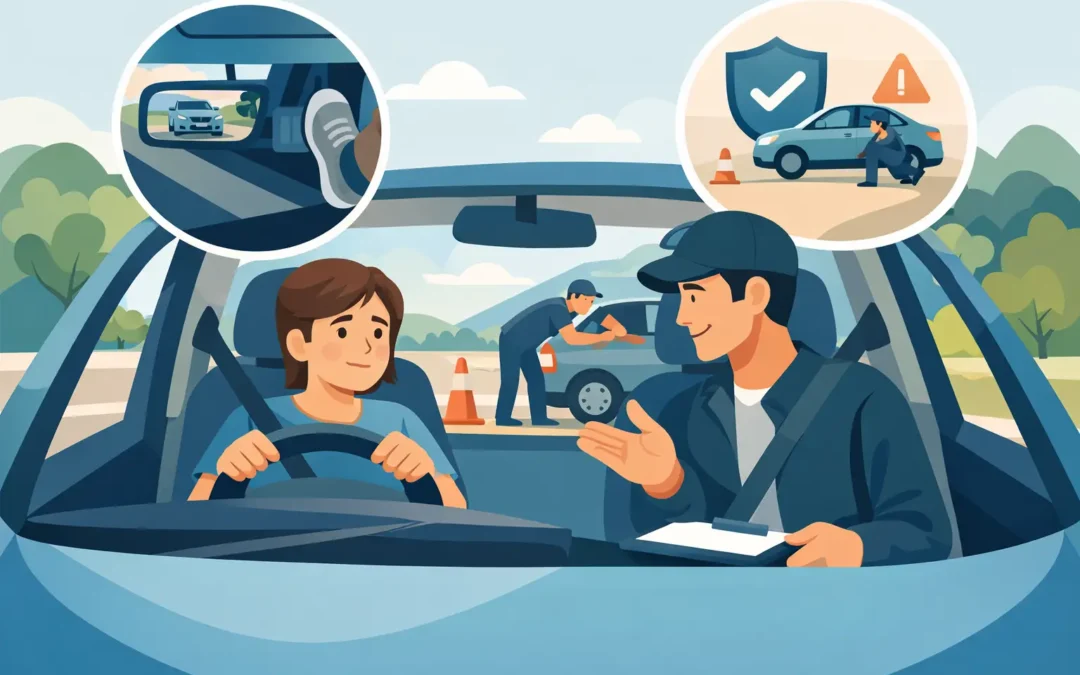
A teen can know every road sign on the permit test and still freeze when it is time to turn left across traffic. That is exactly why safe driving lessons for nervous teens should do more than check off required hours. The right instruction gives a new driver a calm place to make decisions, recover from small mistakes, and build confidence one skill at a time.
Nervousness is not a sign that a teen cannot become a safe driver. Often, it means they understand that driving has real consequences. The goal is not to push that feeling away with pressure. It is to replace uncertainty with repetition, clear coaching, and a plan for what to do in common driving situations.
Why nervous teens need a different pace
A nervous student may hesitate at green lights, brake too early, grip the steering wheel tightly, or worry so much about the cars behind them that they stop scanning ahead. These habits are common at the beginning, but they can become harder to change when a teen feels rushed or embarrassed.
Safe instruction starts by lowering the pressure without lowering the standard. A student still needs to learn lane control, safe following distance, right-of-way rules, parking, freeway driving, and defensive driving habits. The difference is how those skills are introduced. A qualified instructor breaks a complex task into manageable actions and gives feedback while the student can still use it.
For example, a left turn is not simply “go when it is safe.” A teen needs to learn where to position the vehicle, how to judge approaching traffic, where to look for pedestrians, when to wait, and how to complete the turn smoothly. Once those steps become familiar, the situation stops feeling like one large, scary decision.
What safe driving lessons for nervous teens should include
The best lesson plan is structured, gradual, and personalized. It should begin with a quick assessment of the student’s comfort level and prior experience. A teen who has never driven should not be treated like a permit holder who has practiced for months but struggles with freeway merges.
A calm first lesson
The first behind-the-wheel lesson should establish basic control in a lower-stress setting. This may include adjusting the seat and mirrors, learning the vehicle controls, smooth braking, steady acceleration, turns at quiet intersections, and proper stopping at signs.
Starting this way is not “taking it easy” in a way that leaves a student unprepared. It gives the teen enough mental space to learn correct habits before traffic becomes more demanding. Early success matters. When a student sees that they can control the car safely, they are more willing to attempt the next challenge.
Clear coaching instead of constant correction
Nervous teens need direct instructions, but they do not benefit from a stream of criticism. Good coaching is specific: “Check the crosswalk before your turn,” “Ease off the accelerator sooner,” or “Bring your eyes farther down the road.” That type of feedback tells the student what to change and why it matters.
The instructor should also explain what the student did correctly. Positive feedback is not empty encouragement. It helps a teen recognize safe decisions they can repeat, such as noticing a pedestrian early or leaving enough space behind the car ahead.
Gradual exposure to harder roads
A student who is comfortable in a neighborhood may still be anxious on a busy Anaheim street, near a shopping center, or on an Orange County freeway. Progress should happen in stages. After basic vehicle control, lessons can move to busier intersections, multi-lane roads, lane changes, parking lots, freeway entrances, and freeway exits.
The sequence depends on the teen. Some students need more work on turns and traffic awareness before they are ready for freeway driving. Others understand the basics but need repeated practice merging at speed. There is no benefit to forcing the next step before the student can manage the current one safely.
Practice that reflects the DMV road test
Road test preparation is valuable because it turns a vague fear into a specific set of skills. Students should practice common test areas such as safe turns, lane changes, backing, curb parking where required, speed control, observation, and following directions.
However, a road test lesson should not become a memorization exercise. DMV examiners look for safe judgment, not just a rehearsed route. A teen who can calmly check mirrors, scan intersections, maintain space, and respond to changing traffic is better prepared for both the test and everyday driving.
How parents can support a nervous new driver
Parents play a major role in a teen’s progress, especially during the required practice hours. In California, teens under 18 generally need professional behind-the-wheel training as well as supervised practice before taking the drive test. Families should verify current DMV requirements before scheduling the test, since rules and documentation can change.
The most helpful practice drives have one clear focus. Instead of saying, “Let’s work on everything,” choose a goal such as smoother stops, right turns, parking, or safe lane changes. A short drive with a purpose is often more productive than an hour of stressful, unfocused driving.
It also helps to avoid coaching from emotion. If a parent is worried, the teen will usually notice. Give directions early, use a normal speaking voice, and save detailed feedback until the vehicle is safely parked. If a practice session is going badly, it is reasonable to stop, discuss what happened, and try again another day.
Professional lessons can reduce family tension because the instructor handles the teaching while the parent can focus on supporting consistent practice. Teen Driving Academy has worked with more than 75,000 clients since 1990, and its DMV-licensed, pre-screened instructors provide the structured guidance many first-time drivers need.
Signs a teen is building real confidence
Confidence is not the same as being eager to drive everywhere immediately. A safe new driver may still feel cautious in unfamiliar traffic. The better measure is whether the teen can follow a process without becoming overwhelmed.
Look for steady improvement in a few areas: smoother steering and braking, regular mirror checks, earlier recognition of hazards, less hesitation at appropriate gaps, and an ability to recover calmly from a missed turn or imperfect park. These are practical signs that the student is learning to think ahead rather than react at the last second.
A teen should also be able to explain their decisions. Ask why they waited at an intersection, why they changed lanes when they did, or what they noticed before slowing down. If they can describe the safety reason behind an action, they are moving beyond simply following instructions.
Choosing the right driving school and package
For nervous teens, convenience matters, but instructor quality matters more. Look for a school that specializes in teen instruction, uses DMV-licensed instructors, clearly explains its lesson packages, and has experience preparing students for California licensing requirements.
Consider the teen’s starting point when choosing a package. A student with no driving experience may benefit from more than the minimum professional lessons, while a teen who has practiced regularly may need targeted support with freeway driving, parking, or road test readiness. More lessons are not automatically necessary, but enough guided practice can prevent a student from taking the DMV test before they are truly ready.
Families with busy schedules may also value services that reduce test-day stress, such as transportation to the DMV and use of the school vehicle for the road test. For a nervous teen, driving a familiar training vehicle can remove one more unknown from an already high-pressure day.
The safest path to a license is not the fastest possible path. It is the path that gives a teen enough practice to make calm, responsible choices when an instructor or parent is no longer in the passenger seat. Start with a lesson plan that meets the student where they are, then let consistent practice turn nervousness into capability.