
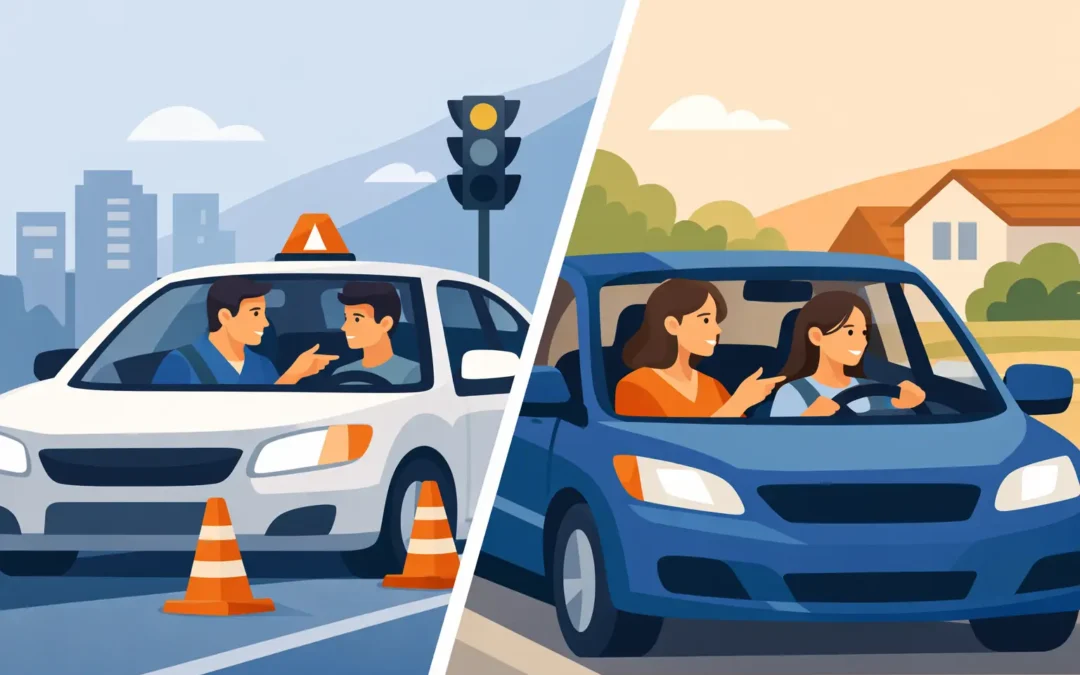
Most families start with the same question: driving school vs parent practice – which one actually helps a teen become a safe, confident driver faster? In California, the honest answer is usually not one or the other. It depends on the teen, the parent’s schedule, and how much structure the learning process needs.
For some teens, parent-led practice works well because it offers more seat time and a familiar environment. For others, formal lessons with a licensed instructor make the biggest difference because the training is consistent, objective, and built around current road test expectations. If your goal is not just getting a license, but building safe habits that last, it helps to understand what each option does best.
Driving school vs parent practice: what changes the outcome?
The biggest difference is structure. A driving school follows a step-by-step process. Lessons are designed to introduce skills in a logical order, from basic vehicle control to lane changes, city driving, parking, freeway driving, and test preparation. That structure matters because teen drivers usually do better when expectations are clear and each lesson builds on the last one.
Parent practice is more flexible, which can be a strength or a weakness. A parent can give extra time on turns, backing up, neighborhood driving, or busy intersections. But flexibility can also become inconsistency. One week a teen practices every day, the next two weeks everyone is too busy. Skills improve best with regular repetition, not random sessions squeezed in when time allows.
Another factor is objectivity. Licensed instructors teach without the family dynamic. That can lower stress for teens who shut down when a parent gets nervous, frustrated, or overly critical. Parents usually mean well, but even calm parents can send mixed signals when they are balancing safety, emotion, and instruction at the same time.
Where driving school has a clear advantage
A professional school is especially useful when a teen is brand new behind the wheel. The first lessons shape habits quickly. Good instruction early on can prevent common problems like overcorrecting, late braking, poor mirror checks, wide turns, and weak scanning at intersections.
Professional instruction also helps when families want confidence that training is current and compliant. In California, teen driver training is not just about learning to move a car. It is about learning the rules, practicing defensive driving, and preparing for real traffic situations. A DMV-licensed, pre-screened instructor is trained to teach those skills in a way that is consistent and measurable.
There is also the convenience factor, and for many parents that is not a small issue. Working families often struggle to fit regular practice into packed schedules. A structured lesson package gives the teen a defined plan and gives the parent fewer logistics to manage. That matters even more when road test support, vehicle use, and DMV transportation are part of the process.
Formal lessons can also uncover blind spots that parents may miss. A parent who has driven for 20 years may do many things automatically and not explain them well. An instructor is trained to break those same skills into teachable steps. That often leads to faster improvement.
Where parent practice still matters
Parent practice is not the backup plan. It is a major part of learning to drive well. No professional lesson package can replace the value of repeated practice in everyday conditions. Teens need time to become comfortable with traffic flow, speed control, parking, left turns, and decision-making under normal pressure.
Parents also know their teen better than anyone else. They know whether the student needs more confidence, more repetition, or more challenge. A parent can choose routes based on the teen’s comfort level and slowly increase difficulty. That kind of gradual exposure is useful, especially for nervous beginners.
Cost is another reason families lean on parent practice. Professional training is an investment, and not every family wants every hour of instruction to come from a school. Using parent practice to reinforce what a teen learns in formal lessons can stretch the value of paid instruction without lowering the quality of training.
Then there is simple volume. The more safe, supervised hours a teen gets, the better. Parent practice usually provides the extra repetitions that turn a skill from something a teen can do once into something they can do reliably.
The common problems with parent-led teaching
The biggest issue is not effort. It is consistency. Parents often start strong and then run into normal life. Work runs late. Weekends fill up. Siblings have activities. Practice gets postponed, then delayed again. A teen may technically be learning, but not on a schedule that builds momentum.
Another problem is tension in the car. Teens are already managing a lot at once – mirrors, signals, lane position, braking, and traffic awareness. If the parent is anxious or reacting sharply, the teen may focus more on the parent’s tone than on the road. Even a good relationship outside the car can feel different during driving practice.
Parents can also teach habits that do not help on the road test or, more importantly, in real-world safety. Rolling stops, one-handed turns, weak blind spot checks, and casual lane changes can become normalized if nobody corrects them early. That does not mean parents are poor teachers. It means familiarity sometimes hides mistakes.
The common limits of driving school
Driving school is not magic. A few lessons do not replace steady practice between sessions. If a teen takes formal lessons but rarely drives otherwise, progress may be slower than expected.
It is also important to choose a school that specializes in teen training and offers licensed instructors, clear lesson packages, and practical scheduling. Not all programs are equally organized. Families should look for credibility, straightforward service details, and a proven track record with teen permit holders.
A good school should make the process easier, not more confusing. That means transparent pricing, realistic expectations, and lesson plans that fit where the student is now – not a one-size-fits-all approach.
The best answer for most families
For most California teens, the strongest plan is a combination of both. Start with professional behind-the-wheel lessons to build the right foundation. Then use parent practice to reinforce each skill in between sessions. That approach gives the teen expert guidance and enough repetition to become comfortable in real traffic.
Think of it this way: the instructor sets the standard, and the parent helps the teen keep practicing until that standard feels natural. One brings structure and objectivity. The other adds time and familiarity. Together, they usually produce better results than either one alone.
This blended approach also reduces stress for parents. Instead of teaching every skill from scratch, parents can support what has already been introduced by a professional. That often makes practice drives calmer and more productive.
How to decide what your teen needs right now
If your teen is very nervous, has never driven, or argues with correction, start with a driving school. The neutral environment can help them focus and build confidence without family pressure.
If your teen already has basic comfort behind the wheel and your family has the time to practice regularly, parent practice can do a lot of the heavy lifting. But it still helps to bring in a professional for skill checks, freeway training, parking refinement, and road test preparation.
If the goal is the fastest, clearest path from permit to license, structure usually wins. Families in busy areas like North Orange County often find that a scheduled lesson package keeps progress moving when life gets hectic. That is one reason many parents choose a school such as Teen Driving Academy for the formal part and then handle additional practice at home.
What matters more than the debate
The real question is not whether driving school or parent practice is better in theory. It is whether your teen is getting enough quality instruction, enough supervised time, and enough feedback to correct mistakes before they become habits.
A teen who practices often with weak guidance may feel confident but still be unprepared. A teen who takes lessons with a professional but never practices outside them may understand the rules but still lack fluency. Safe driving comes from both instruction and repetition.
If you are choosing between the two, do not treat it like an all-or-nothing decision. Start with the option that fills your biggest gap. If you need structure, go with professional lessons. If you need more practice hours, commit to a regular family driving schedule. The best plan is the one your family will actually follow through on.
Your teen does not need a perfect path to become a better driver. They need consistent practice, clear coaching, and enough support to keep improving one drive at a time.