
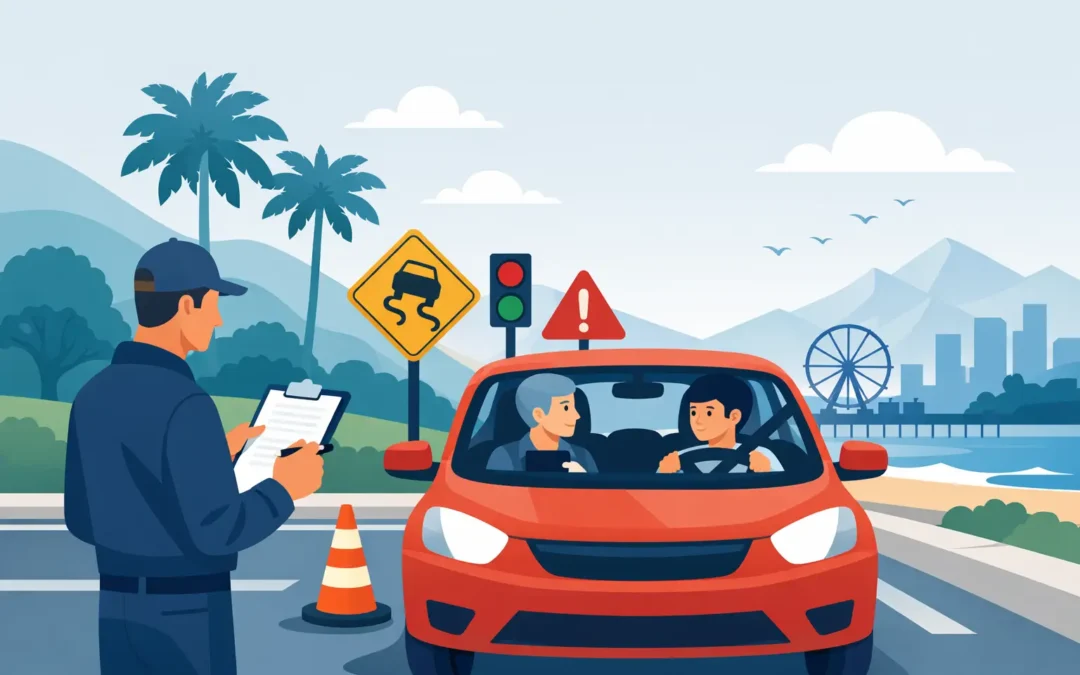
A lot of teens imagine the driving test as one high-pressure moment where every small mistake means automatic failure. That is usually not how it goes. If you are wondering what happens during road test appointments in California, the better way to think about it is this: the examiner is checking whether you can drive safely, follow directions, and make steady decisions in normal traffic.
For most students, the road test feels much more manageable once they know the sequence ahead of time. Parents also tend to relax when they understand what the examiner is actually looking for and what can cause a test to end early. The more familiar the process feels, the easier it is to stay calm and drive the way you practiced.
What happens during road test check-in
The appointment starts before the car moves. You will arrive at the DMV, check in, and make sure you have the required documents. If you are using your own car, it must be registered, insured, and in safe working condition. If you are using a driving school vehicle, that part is usually simpler because the car is already prepared for test day.
Before the examiner begins the actual driving portion, they usually do a quick vehicle safety check. They may ask you to show hand signals and confirm that the brake lights, horn, windshield, mirrors, and turn signals are working. This is not a trick. It is a basic check to make sure the vehicle is legal and safe for the exam.
That part matters more than some families expect. A student can be fully ready to drive and still have a problem if the car has a cracked windshield in the wrong spot, a warning light issue, or brake lights that do not work. That is one reason many parents prefer a road test service with a training vehicle.
What happens during road test driving
Once the examiner gets in the car, they will explain that they are there to give directions, not coach you through the drive. They are not expecting perfection. They are watching for safe habits, awareness, and control.
The test usually begins in lower-speed streets near the DMV. You may be asked to make right turns, left turns, lane changes, and controlled stops. In many cases, you will also drive through residential areas and business streets where speed control and observation matter a lot. Some routes include wider roads with more traffic. Others stay relatively simple. It depends on the DMV location and road conditions that day.
In California, the standard road test does not usually include freeway driving. That surprises some students. Even without the freeway, though, the test still covers real-world situations where teen drivers need to show judgment. The examiner wants to see how you scan intersections, respond to signs, check blind spots, and keep a safe following distance.
You may also be asked to back up in a straight line for a short distance along a curb. This is one part students often overthink. The examiner is not expecting a dramatic maneuver. They are checking whether you can control the vehicle smoothly while looking carefully and staying aware of your surroundings.
What the examiner is really grading
The biggest misunderstanding about the driving test is that students think it is only about avoiding big mistakes. That is part of it, but not the whole picture. The examiner is also looking for consistent habits from start to finish.
That includes how you hold the wheel, how smoothly you accelerate and brake, whether you stop behind limit lines, and whether you look left, right, and ahead instead of staring only straight in front of the car. Good drivers make their awareness visible. If you check mirrors and blind spots naturally and regularly, the examiner can see that you are processing what is happening around you.
Speed is another major area. Driving too fast is obviously a problem, but driving too slowly can also create issues if it disrupts traffic or shows hesitation. The goal is to match conditions, obey posted limits, and move with reasonable confidence.
Turns are closely watched too. The examiner wants to see proper lane position, steady braking, use of signals, and good observation before and during the turn. Wide turns, cutting corners, or missing checks for pedestrians can hurt your score quickly.
Common mistakes that can cost points
Most students do not fail because of one tiny technical issue. They lose points through a pattern of weak observation, late decisions, or nervous habits. A few common examples come up again and again.
One is incomplete stops. Rolling through a stop sign, even slightly, is one of the easiest ways to create a bad impression. Another is forgetting blind spot checks before pulling away from the curb, changing lanes, or merging. Some students also signal too late, brake too hard, or drift in the lane when they are distracted by the examiner’s instructions.
There is also a difference between being cautious and being hesitant. Waiting for a safe gap is good. Waiting too long when it is clearly your turn can signal a lack of confidence or judgment. The examiner wants to see safe decision-making, not fear-based driving.
Mistakes that can lead to automatic failure
Some errors are more serious and may cause the test to end right away. These are often called critical driving errors. The exact situation matters, but examples can include dangerous lane changes, running a red light, ignoring a stop sign, causing another driver to take action to avoid you, or creating risk for a pedestrian.
If the examiner has to intervene verbally in a serious way or physically in some situations, that can also be enough to fail the test. Hitting a curb hard, speeding in a school zone, or showing a clear lack of control may have the same result.
This is why practice should focus on judgment, not just memorizing a route. A student who understands right-of-way, scanning, and speed management is usually in a better position than someone who only repeated the same streets without learning the why behind each action.
How to prepare for what happens during road test day
The strongest preparation is simple, structured, and realistic. Practice in the same type of traffic you are likely to see on the test. That means residential streets, busy intersections, lane changes, unprotected left turns, and parking lot exits. If a teen has only practiced in quiet neighborhoods, the DMV route may feel harder than expected.
It also helps to practice with test-style driving. That means following directions without extra coaching, checking mirrors and blind spots clearly, and talking less so the driver can focus. Many parents mean well but accidentally over-instruct, which creates dependence. On test day, that support is gone.
A professional lesson shortly before the exam can make a real difference. An experienced instructor can spot small habits that parents may miss, such as late scanning, uneven stops, or weak lane positioning. For many families, that final tune-up is what turns a nervous permit holder into a test-ready driver.
If test-day logistics are adding stress, using a DMV test service can also help. Having transportation to the DMV and a properly prepared vehicle removes two common problems at once. That convenience matters, especially for working parents and first-time testers.
What teens should expect emotionally
Even well-prepared students get nervous. That is normal. The key is not trying to eliminate nerves completely. The goal is to keep them from changing your driving habits.
A good rule is to drive a little slower in your mind, not on the road. Listen carefully, take a breath before each maneuver, and focus on one decision at a time. If the examiner writes something down, do not assume it means you made a major mistake. Examiners write notes throughout the test.
If you make a small error, keep going. One imperfect turn does not automatically mean failure. Many students hurt themselves more by panicking after a minor mistake than by the mistake itself.
After the road test
Once the drive is over, the examiner will go over the result with you. If you pass, they will explain the next steps. If you do not pass, you will usually be told what needs improvement before you return.
That feedback can be useful if you treat it as a practice roadmap rather than a setback. Plenty of safe drivers do not pass on the first attempt. What matters is identifying the pattern, correcting it, and coming back better prepared.
For teens and parents, the road test is really the last checkpoint in a longer process. It should confirm the skills already built through solid training, enough supervised practice, and calm preparation. If you know what happens during road test appointments and you prepare for the actual driving decisions involved, the experience becomes much less intimidating and much more manageable. The goal is not to impress the examiner. It is to show that you can drive safely when it counts.