
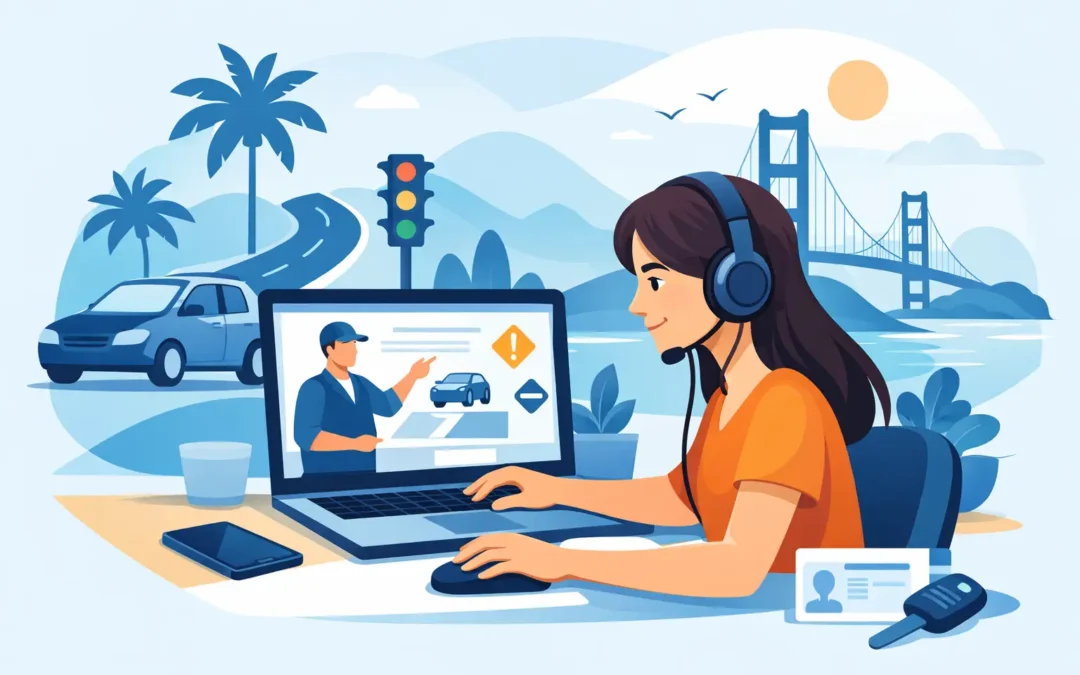
If your goal is to get a California learner’s permit without turning your family schedule upside down, drivers ed online is usually the fastest place to start. For most teens, it removes the biggest early obstacle – finding time for a classroom course, getting rides across town, and waiting weeks to begin. For parents, it offers a simpler, more manageable way to keep the licensing process moving.
That convenience matters, but it is not the only reason online driver education has become the standard choice for many families. The better question is whether it gives teens the right foundation before they get behind the wheel. The answer depends on the course, the student, and what happens after the certificate is earned.
How drivers ed online fits into the California process
In California, teens under 18 must complete an approved driver education course before they can take the written knowledge test for a learner’s permit. That is where drivers ed online comes in. It covers the rules of the road, traffic laws, road signs, defensive driving basics, and the safety concepts teens need before real-world practice starts.
After finishing the course, the student receives a certificate of completion that is used as part of the permit process. From there, the next steps usually include passing the written DMV test, practicing with a permit, completing required behind-the-wheel training, and building enough experience to take the driving test.
This is why online education should be viewed as the first stage, not the full solution. It gets the academic requirement done efficiently, but safe driving skills still have to be taught in the car, over time, with supervision and structure.
Why drivers ed online works for busy families
The biggest advantage is flexibility. Teens can complete lessons from home, on a laptop or tablet, and work around school, sports, jobs, and family obligations. Parents do not need to coordinate repeated classroom drop-offs, which makes a noticeable difference for households already balancing packed calendars.
A self-paced format also helps students absorb information differently. Some teens move quickly through familiar material and slow down when they reach sections on right-of-way, DUI laws, or accident prevention. In a fixed classroom, everyone moves at the same speed whether they are ready or not.
There is also a practical financial angle. Online courses are often a more efficient starting point than in-person classroom programs because they reduce travel time and can help families begin the permit process sooner. When a teen is motivated, that momentum matters. Delays early on often push everything else back, including practice driving and road test scheduling.
What to look for in a drivers ed online course
Not all programs offer the same value. A low price may look appealing, but parents should pay attention to approval, clarity, support, and what happens after the course ends.
First, make sure the program is approved for California requirements. If the course does not satisfy the state’s standards, it does not matter how easy the platform is to use. The certificate has to count.
Second, look at how the material is presented. Teens are more likely to finish a course when the lessons are straightforward, readable, and organized in a way that feels manageable. Dense text and confusing navigation create drop-off points. A fast-start course should still be thorough, but it should not feel harder to use than the DMV handbook itself.
Third, think beyond the online portion. Many families benefit from working with a school that can also provide behind-the-wheel lessons, package options, and help with the next stage. A single provider can reduce confusion and save time because the handoff from permit prep to in-car training is more direct.
The trade-off: convenience versus accountability
Online learning is convenient, but convenience has a trade-off. Some teens do well with independence. Others start strong and then leave the course unfinished for weeks. That is not a problem with the format itself. It simply means self-paced learning works best when there is some accountability at home.
Parents can help by setting a simple schedule. Even 30 to 45 minutes at a time is enough to keep steady progress. The goal is not to rush through the material just to get a certificate. The goal is to make sure the student understands what they are reading well enough to apply it later under pressure.
This is also where a teen-focused school has an advantage. Programs built specifically for first-time drivers tend to explain concepts in a way that is more relevant to younger students. They are not trying to serve every type of driver at once. That usually leads to clearer instruction and fewer misunderstandings.
Does online driver education actually prepare teens?
It prepares them for the knowledge side of driving, which is necessary, but not sufficient on its own. Reading about blind spots is not the same as checking them correctly in traffic. Memorizing stop sign rules is not the same as managing a four-way stop with impatient drivers around you.
That does not make online education less useful. It makes it realistic. Drivers ed online is best at building awareness before the student ever starts the car. It introduces the language, laws, penalties, and safety habits that should already be familiar once behind-the-wheel lessons begin.
When the online course and in-car instruction are connected, teens tend to progress more smoothly. They recognize terms faster, understand the reason behind corrections, and spend less time trying to learn basic rules during active driving practice.
Why parents should care about the next step now
A common mistake is treating permit prep and driver training as separate decisions made at different times. In reality, they are connected from day one. The quality of the first step often shapes how confident and organized the rest of the process feels.
If a family chooses a course from a school that also offers licensed, pre-screened instructors and structured behind-the-wheel packages, the transition is easier once the permit is issued. There is less scrambling to compare providers later. There is also more continuity, which can be reassuring for both teens and parents.
For families in North Orange County and nearby communities, that local continuity can be especially valuable. A provider that knows the area, understands the practical challenges new drivers face on local roads, and offers coordinated services can take a lot of friction out of the process.
When drivers ed online is the right choice
For most California teens, it is the right choice when the priority is getting started quickly, meeting state requirements efficiently, and keeping the process flexible. It is especially useful for students with busy school schedules and for parents who want a clear, convenient path rather than a series of separate steps.
It may be less ideal for students who struggle with self-directed learning and need a lot of live instruction to stay engaged. Even then, online education can still work if parents stay involved and the school provides responsive support.
The key is choosing a program that is not just convenient, but credible. Experience matters. A school that has worked with teen drivers for years and helped thousands of families is usually better equipped to explain the process clearly and keep students moving forward without confusion.
Teen Driving Academy is one example of that model – combining online driver education, behind-the-wheel training, and DMV test support in a way that is built around teen drivers instead of treating them like an afterthought.
What a smart start looks like
A smart start is simple. Enroll in an approved online course, finish it without dragging the process out, prepare seriously for the DMV written test, and line up behind-the-wheel training early. That sequence gives teens structure and gives parents fewer surprises.
The best part of drivers ed online is not that it makes licensing effortless. It is that it removes unnecessary delay. When the course is clear, the provider is credible, and the next step is already in place, teens can focus on becoming safe, confident drivers instead of getting stuck in the process.
If your family is ready to move forward, start with a course that makes the permit stage easier and the training stage more organized. A smoother beginning usually leads to a calmer road ahead.