
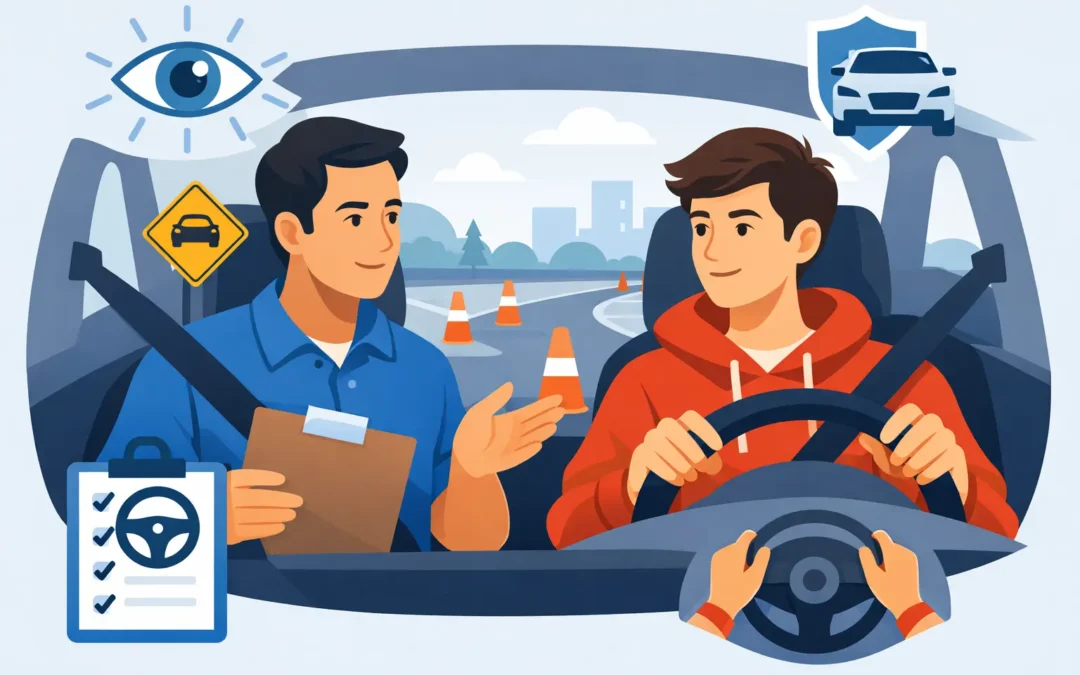
A teen’s first time behind the wheel should not feel like a rushed errand between school, work, and sports. Licensed teen driving instructors give new drivers a structured place to learn the habits that matter most: checking mirrors, managing speed, reading traffic, making safe turns, and staying calm when conditions change.
For parents, professional instruction also takes pressure off the passenger seat. You can still practice with your teen, but a qualified instructor provides an objective standard, a training vehicle designed for lessons, and guidance based on what the DMV expects from first-time drivers.
Why instructor licensing matters for teen drivers
Not every experienced driver is prepared to teach a teenager. A California driving instructor must meet state requirements and work through a licensed driving school. That matters because teen instruction is more than explaining how to steer, brake, and park. It requires a consistent lesson plan, patient communication, awareness of common beginner mistakes, and a focus on defensive driving.
A licensed instructor knows how to correct a problem before it becomes a habit. For example, a new driver may look directly in front of the car instead of scanning farther down the road. They may brake too late approaching a stop sign, turn too wide, or hesitate at an unprotected left turn. These are normal early-stage issues, but they need clear, timely coaching.
Professional training also helps families distinguish between a mistake that needs more practice and a safety concern that needs immediate attention. A teen who is still learning smooth braking may simply need repetition. A teen who repeatedly fails to check blind spots needs focused instruction before moving on to more complex traffic situations.
What licensed teen driving instructors should teach
Behind-the-wheel lessons should build skills in a logical order. The first lesson often starts with vehicle controls, seating position, mirror adjustment, signaling, lane position, and smooth starts and stops. As confidence improves, instruction should move into residential streets, busier intersections, lane changes, parking, and higher-speed roads when the student is ready.
A quality lesson is not just a drive around town. The instructor should explain the reason behind each decision. When should a driver begin braking? Where should their eyes be scanning? How much space should they leave behind another vehicle? Why is it unsafe to assume another driver will yield?
California teens also need practice in situations that can appear on the DMV driving test and occur in everyday driving. That includes controlled intersections, right and left turns, lane changes, backing up, curbside parking, speed management, and observing pedestrians and cyclists. The goal is not to memorize a test route. The goal is to develop safe judgment that works on any road.
The value of calm, specific feedback
Teen drivers learn best when feedback is direct and manageable. “Be more careful” is not very helpful. “Check the right mirror before moving toward the curb” gives the student a clear action to repeat.
The best instructors balance correction with encouragement. They do not ignore errors, but they also do not create an environment where a teen becomes afraid to make a decision. Confidence should come from preparation and practice, not from being told everything is fine when it is not.
This is especially useful for students who are nervous, highly cautious, or overwhelmed by traffic. A patient instructor can slow the lesson down, repeat a skill, and increase difficulty gradually. On the other hand, a teen who feels very confident may need reminders to avoid speeding, rolling stops, rushed turns, and other overconfident driving behaviors.
Professional lessons and parent practice work together
A driving school does not replace parent-supervised practice. California requires teen permit holders to complete practice with a qualified parent, guardian, spouse, or other licensed adult who meets the state’s age requirements. Before taking the driving test, minors generally need at least 50 hours of supervised practice, including 10 hours at night, as well as the required professional behind-the-wheel training.
The two types of practice serve different purposes. Licensed lessons provide a structured curriculum and professional assessment. Parent practice gives teens the repetition they need in familiar routes, changing traffic conditions, nighttime driving, and real-life trips such as school, work, or activities.
Parents can get more value from practice time by asking the instructor what to reinforce between lessons. If a student needs help with lane changes, practice that one skill on appropriate roads rather than trying to cover every possible task in one drive. If parking is the challenge, schedule short sessions in a low-pressure area and repeat the same process until it feels natural.
Consistency matters more than marathon practice sessions. Two focused drives each week are often more effective than one long drive once a month. Skills fade when there is too much time between practice opportunities.
How to choose the right driving instructor and school
Families should look beyond the lowest advertised price. A cheap lesson is not a good value if it does not provide enough time, clear instruction, or a plan for the student’s next steps. Compare what each package includes, how long each lesson lasts, whether the school works specifically with teens, and how scheduling is handled.
Before enrolling, confirm these practical details:
- The school and instructors are properly licensed in California.
- The instructor has experience teaching first-time teen drivers.
- Lessons are conducted in a school vehicle equipped for driver training.
- The school can explain its lesson structure and California completion requirements.
- Scheduling, cancellation policies, pricing, and service areas are clear before purchase.
It also helps to ask how progress is communicated. Parents do not need a play-by-play report after every lesson, but they should understand what their teen has covered and what needs more work. A good school makes that information easy to obtain.
For families in North Orange County and nearby communities, convenience can be a meaningful factor. Pickup options, flexible lesson times, online driver education, and DMV test support can reduce the number of workday schedule changes parents have to manage. If a student is preparing for the road test, transportation to the DMV and use of a school vehicle may also provide useful familiarity and reduce last-minute stress.
When a teen is ready to move toward the DMV test
Readiness is not based on how long a teen has held a permit or how eager they are to get a license. It is based on consistent decisions. A road-test-ready student can follow directions, maintain proper speed, make complete stops, check mirrors and blind spots, control the vehicle smoothly, and recover safely from small errors without panicking.
A student does not need to drive perfectly to be ready. Few new drivers do. They do need to show sound judgment without constant prompting. If an instructor still has to remind a teen to scan intersections, signal, or check blind spots, more practice is usually the better choice.
A pre-test lesson can be especially helpful because it identifies the details that often cost students points: stopping behind the limit line, maintaining lane position during turns, checking traffic before pulling away from the curb, and keeping both hands ready for control. It can also help a teen understand that the examiner is watching safe habits throughout the drive, not only during parking maneuvers.
A practical path forward for California families
The right driving program should make the licensing process easier to understand, not harder. Start with driver education if your teen still needs a learner’s permit. Once they have a permit, schedule professional lessons early enough to allow time for practice between sessions. Keep a record of supervised hours, including nighttime driving, and avoid waiting until the week before the DMV appointment to address weak areas.
Teen Driving Academy has helped California students build these skills since 1990 through DMV-licensed instruction, online education, behind-the-wheel packages, and road test support. The right package depends on where your teen is starting, how much supervised practice is available at home, and whether they need extra preparation before the DMV test.
A driver’s license is a major milestone, but the better outcome is a teen who knows how to make safe choices when no instructor or parent is sitting beside them. Start with professional guidance, practice consistently, and give your new driver the time needed to become genuinely prepared.