
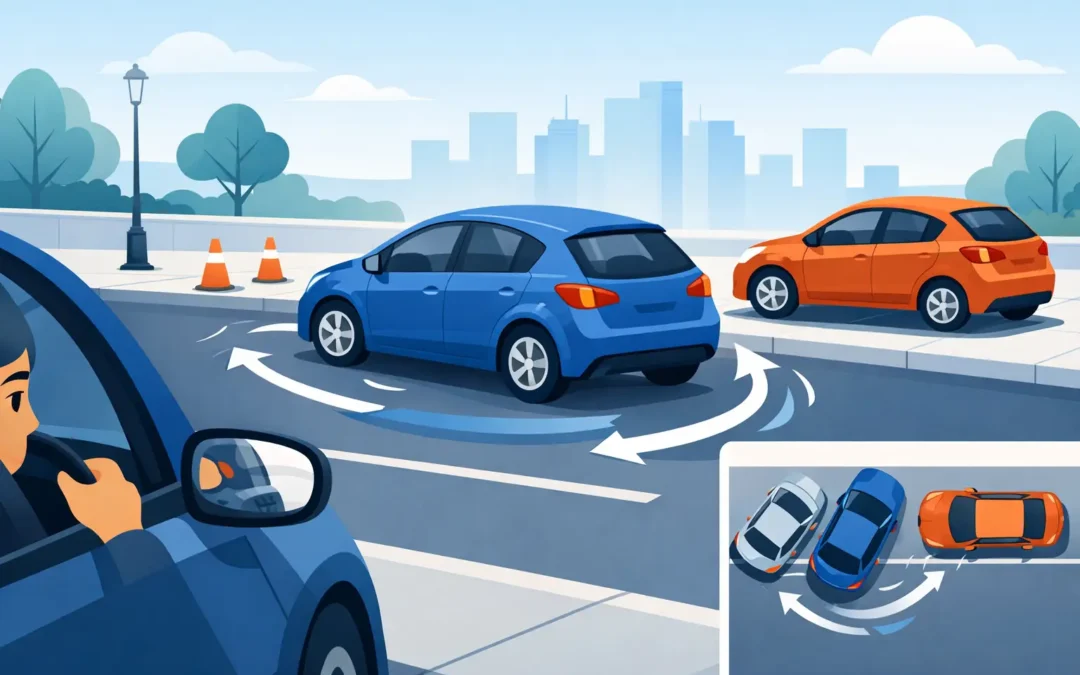
That tight space at the curb can make even a careful teen driver tense up. If you want to learn how to parallel park confidently, the goal is not to force one perfect method every time. The real goal is to understand the setup, move slowly, and know how to fix the car’s position without panicking.
For most new drivers, parallel parking feels harder than it is because it happens close to other cars, with limited room for mistakes. Parents feel that pressure too. Nobody wants a rushed correction, a tapped bumper, or a stressful road test. The good news is that parallel parking is a skill, not a talent. Once the sequence makes sense, confidence usually follows.
Why parallel parking feels intimidating
Parallel parking asks you to do several things at once. You have to judge distance, control speed, turn the wheel at the right time, check traffic, and stay calm while the car moves backward. That is a lot for a new driver.
It also feels public. On a quiet practice street, a mistake is just a mistake. On a busier road, it can feel like everyone is watching. That pressure causes many teens to rush the setup, turn too sharply, or stop checking mirrors. In reality, slower is better. A careful driver who takes an extra few seconds usually parks better than a nervous driver who tries to finish fast.
How to parallel park confidently step by step
The exact reference points vary a little by vehicle size, seating position, and curb height, so treat these as a reliable starting method rather than a rigid rule. With practice, you will adjust based on the car you are driving.
1. Pick a space that gives you room
When you are learning, choose a space that is clearly longer than your car. Trying to squeeze into a tight spot too early can make the whole skill feel harder than it needs to be. On a road test or in real traffic, you may not always get a huge space, but training in a forgiving space helps you build control first.
Signal early and pull up next to the parked car in front of the open space. Your car should be about two to three feet away from that vehicle, roughly parallel to it. If you start too far out, you may end up too far from the curb. If you start too close, you may cut in too sharply.
2. Stop evenly with the other car
A good basic setup is to align your rear wheels near the rear bumper of the car next to you. In some cars, drivers use their side mirrors or door position as a guide. The exact marker matters less than consistency. Use the same starting point each time in the same vehicle so your brain starts to recognize the pattern.
Before moving, check your mirrors, look over your shoulder, and make sure no cars, bikes, or pedestrians are coming through.
3. Back up slowly and begin the first turn
Shift into reverse and move at a crawl. Turn the steering wheel toward the curb as you begin backing in. Keep your speed slow enough that you could stop immediately if needed. That low speed is what gives you options.
As the rear of your car enters the space, keep checking behind you and toward the curb. Many beginners focus only on the car in front, but the curb matters just as much. You are trying to guide the rear of the car in without getting too close too early.
4. Straighten briefly, then turn the other way
Once your car is angled into the space, straighten the wheel for a moment as needed, then turn the wheel away from the curb to bring the front of your car in. This is the part that often feels awkward at first. If you wait too long, the rear tire may get too close to the curb. If you turn too soon, the front of your car may still stick out into the lane.
This is why practice matters. The timing becomes easier once you have repeated it enough times to see how your vehicle responds.
5. Center the car in the space
After your car is fully inside the space, straighten the wheel and adjust as needed. Pull forward or back slightly so you are not too close to the car ahead or behind. Aim to park parallel to the curb, close enough to look neat and legal, but not so close that you risk scraping the tire or wheel.
A clean finish does not always happen in one move. Small corrections are normal. In fact, making a calm correction is part of parking confidently.
The visual cues that help most new drivers
Reference points are useful, but they are not universal. A sedan, SUV, and compact car all behave differently. Your height in the driver’s seat changes what you see, too.
Still, a few cues help most students. First, watch the relationship between your car and the parked car beside you during setup. Second, use your side mirrors to monitor curb distance as you back in. Third, look over your right shoulder often rather than relying only on the backup camera, especially because road tests typically expect active observation.
A backup camera can help, but it should support your awareness, not replace it. Drivers who depend on the screen alone often miss what is happening around the vehicle.
Common mistakes and how to fix them
One of the most common problems is starting with poor alignment. If your setup is off, the rest of the maneuver usually feels messy. Resetting is better than forcing it.
Another common issue is turning the wheel too quickly while backing too fast. That combination makes the car swing in before you have properly judged the space. Slow the car first, then steer.
Some drivers also stop checking around them once they begin reversing. That is risky. Keep scanning mirrors, checking over your shoulder, and staying aware of passing traffic.
If you end up too far from the curb, pull out and try again with a slightly closer starting position. If you are too close to the curb too early, you probably turned in too sharply or too soon. If the front of the car is still sticking out, you may need to pull forward, straighten, and back in again with better timing on the second turn.
There is no prize for fixing a bad angle in one heroic move. Safe drivers reset when needed.
How to practice parallel parking without the stress
The best way to build confidence is controlled repetition. Start on a quiet residential street with little traffic. Use cones if available, or practice near curb space with no nearby cars before moving on to tighter real-world setups.
Give yourself one goal per session. One day, focus only on the setup. Another day, focus on curb distance. Another day, work on making one smooth correction after the initial park. Breaking the skill into pieces keeps practice from feeling overwhelming.
If a parent is coaching, keep instructions short. Too much talking in the middle of the maneuver can make a teen freeze or overcorrect. It helps to agree on a few simple phrases such as stop, straighten, cut right, or pull forward and reset.
For California teens preparing for their road test, practice the way you will actually be evaluated – scanning properly, signaling, controlling speed, and parking without depending completely on technology. A trained driving instructor can often shorten the learning curve because they know how to match the method to the student’s vehicle and habits.
How to parallel park confidently on a driving test
A road test is different from casual practice because nerves change everything. The trick is to simplify the task. Do not think about impressing the examiner. Think about following your routine.
Signal, position the car carefully, check all around, and back up slowly. If your first angle is not perfect, make a calm correction. Examiners are looking for control, safety, observation, and judgment. They are not expecting a dramatic one-shot parking move.
What hurts most drivers on a test is not a small adjustment. It is rushing, forgetting observations, or getting flustered after a minor error. If you stay calm and keep working the process, you usually do better than you think.
When confidence still is not there
Sometimes the issue is not the parking method. It is lack of enough supervised practice, inconsistent coaching, or driving a different car every time. Confidence comes from repetition in similar conditions.
If your teen understands the steps but still struggles to execute them, more guided behind-the-wheel practice usually helps. That is especially true for permit holders who feel fine driving forward but tense up the moment reverse is involved. Structured lessons can make a big difference because the feedback is immediate, practical, and consistent.
At Teen Driving Academy, this is the kind of skill we work on every day with new drivers who want to feel prepared instead of overwhelmed. The goal is simple – safer habits, better control, and less stress for both teens and parents.
Parallel parking gets easier when you stop treating it like a high-pressure trick and start treating it like a repeatable driving skill. Slow down, set up correctly, and give yourself permission to adjust. Confidence usually shows up right after that.